The Clinical Trial Gap: We Investigated Which Dog Supplement Brands Actually Publish Research
Our Investigations Desk —
On this page
By The DSR Investigations Desk | Published July 30, 2026 | Updated July 30, 2026 | 18 min read
Table of Contents
- Our Investigation
- Methodology
- Key Findings
- The Brand-by-Brand Evidence Table
- What “Clinically Studied” Actually Means
- The Postbiotic Exception
- Why the Gap Persists
- What This Means for Consumers
- Frequently Asked Questions
- References
🔑 Key Findings
- We examined the 15 dog supplement brands with the largest market share or revenue. Only a small minority have published a peer-reviewed, product-level randomized controlled trial[4] (RCT) conducted in dogs on the exact product being sold.
- The vast majority of “science-backed” and “clinically studied” marketing claims refer to studies on individual ingredients — often conducted in humans, mice, or in a test tube — not on the finished product a consumer actually buys.
- The probiotic category is the single most heavily marketed “scientific” segment in pet supplements, yet a 2017 JAVMA review concluded there is “no definitive evidence that probiotics are effective for dogs with chronic diarrhea.”
- By contrast, the emerging postbiotic category — a fraction of the market’s size — has accumulated at least four peer-reviewed canine RCTs and a 2025 systematic review, a higher density of product-level dog evidence than most billion-dollar incumbents.
- The structural reason: pet supplements are regulated as food, not drugs[1]. No agency requires a brand to prove its product works before it is sold.
Our Investigation
Walk the supplement aisle of any pet retailer, or scroll the first page of results for “best dog probiotics,” and you will encounter the same vocabulary repeated like a mantra: science-backed, clinically studied, vet-formulated, research-driven, evidence-based. The language of the laboratory has become the language of pet supplement marketing.
But marketing language is not the same thing as published science[5]. A phrase like “clinically studied” is not a regulated term. It carries no legal definition, requires no minimum standard of evidence[2], and is not verified by any government agency before it appears on a label or a landing page. In practice, it can mean almost anything — from a genuine double-blind trial in dogs to a single in-vitro assay[3] on one ingredient performed a decade ago in a different species.
So we decided to test the claim directly. We identified the 15 dog supplement brands with the largest market share or highest revenue, and we asked a single, narrow question that any consumer could, in theory, verify: Has this brand published a peer-reviewed, product-level randomized controlled trial, conducted in dogs, on the specific product it sells?
Key Finding: For most of the category’s biggest sellers, the answer is no. The industry has mastered the aesthetics of science — white coats, molecular diagrams, PubMed citations on landing pages — while largely declining to do the expensive, risky, publishable work of proving that the finished product in the bottle does what the label implies.
This is not an accusation of fraud. It is a documentation of a structural incentive. When a company can legally sell a supplement without ever demonstrating that it works, the rational business decision is to spend money on marketing that evokes science rather than on research that might disconfirm it. This investigation is about following that money.
Methodology

We built our brand list from publicly reported market-share and revenue figures, cross-referencing multiple market-research firms (MarketsandMarkets, Grand View Research, Fortune Business Insights, IMARC Group) and, for direct-to-consumer brands, reported annual revenue. The 15 brands span the full range of the category: multinational incumbents, veterinary-channel leaders, and venture- or private-equity-backed D2C disruptors.
For each brand, we searched for product-level evidence using the following hierarchy, from strongest to weakest:
- Product-level canine RCT: A peer-reviewed, randomized, controlled trial conducted in dogs, testing the exact finished product sold to consumers. This is the gold standard and the only form of evidence that directly supports a product-specific efficacy claim.
- Product-level canine study (non-RCT): A peer-reviewed study in dogs on the finished product, but without randomization or a placebo control.
- Ingredient-level canine evidence: Peer-reviewed studies in dogs on one or more individual ingredients, but not the finished combination or formulation.
- Ingredient-level evidence from other species[7]: Studies on individual ingredients conducted in humans, rodents, or in vitro, extrapolated to dogs.
- No identifiable published evidence: Marketing claims we could not trace to any peer-reviewed source.
We searched PubMed, Google Scholar, and journal websites, and we reviewed the scientific claims published on each brand’s own site. Where a brand cites a study, we attempted to locate the primary source and confirm what it actually tested. Our classification reflects what we could independently verify as of July 2026. The absence of a published trial in our search does not prove a trial was never conducted — companies may hold unpublished internal data — but it does mean that no independent, peer-reviewed evidence is available for a consumer or veterinarian to evaluate.
Two important caveats. First, several brands are owned by large parent companies (Nestlé, Mars, Elanco, Zoetis) that publish substantial research across their broader portfolios; we scored the specific consumer supplement products, not the parent company’s entire research output. Second, we did not commission or conduct any laboratory testing for this article. Our findings concern the published evidence record, not the underlying quality of any product.
Key Findings
Finding 1: The evidence pyramid is inverted
In a functioning evidence-based market, the best-selling products would also be the best-studied. In the dog supplement market, the opposite is closer to the truth. The brands with the widest distribution and the highest revenue are frequently the ones with the thinnest product-specific evidence, because their scale was built on distribution, branding, and veterinary-channel trust — not on publishable clinical research.
Finding 2: “Clinically studied” almost always means “ingredient studied”
When we traced “clinically studied” claims to their source, they nearly always resolved to studies on a single ingredient — often a branded ingredient supplied by a raw-material vendor who markets the same study to dozens of competing brands. A soft chew containing a “clinically studied” probiotic strain typically means that that strain was studied somewhere, in some formulation, possibly in a different species — not that the specific chew on the shelf was tested in dogs.
Finding 3: The regulatory floor is zero
Under U.S. law, pet supplements are regulated as food, not drugs. The FDA does not require pre-market proof of efficacy. A brand can legally bring a product to market, make structure/function claims (“supports digestive health”), and never run a single clinical trial. Enforcement is complaint-driven and sparse. As we documented in our analysis of the FDA’s structural capacity gap, the agency’s Center for Veterinary Medicine oversees a $50B+ market with roughly 1,500 staff, and its enforcement is reactive rather than proactive.
Finding 4: A small category is quietly out-publishing the giants
The postbiotic segment — inactivated microbial preparations, as distinct from live-culture probiotics — is a tiny slice of the market. Yet a search of the recent literature turns up at least four peer-reviewed canine RCTs on postbiotic preparations, plus a 2025 systematic review and meta-analysis. That is a higher concentration of product-level dog trials than most of the category’s billion-dollar incumbents can claim. We examine why in the section below.
The Brand-by-Brand Evidence Table
The table below summarizes our findings for the 15 brands. “Published Canine RCT on Product?” reflects whether we could identify a peer-reviewed, randomized, controlled trial in dogs on the specific consumer product. “Revenue / Scale” reflects publicly reported figures. “Reality” summarizes what the brand’s scientific claims actually rest on.
| Brand (Parent) | Revenue / Scale | Published Canine RCT on Product? | “Clinically Studied” Claim? | What the Claim Rests On |
|---|---|---|---|---|
| Purina FortiFlora (Nestlé Purina) | Part of $100B+ Nestlé; ~45% category share via lines | Yes — strain SF68 has published canine studies | Yes | Genuine strain-level canine research; veterinary-channel gold standard. Narrow (single strain), but real. |
| Nutramax (Cosequin / Dasuquin / Proviable) | 12–15% OTC market share; privately held | Partial — ingredient/ASU studies; Proviable strain data | Yes | Strong ingredient-level evidence (glucosamine, ASUs). Product-level data thinner than reputation implies. |
| Elanco Animal Health | 16–20% share (public co.) | Varies by product; stronger on pharmaceutical lines | Yes | Robust research infrastructure, but concentrated in drugs/parasiticides; OTC supplement evidence mixed. |
| Zoetis | 13–17% share (public co.) | Strong on drugs; limited on consumer supplements | Yes | Pharmaceutical-grade R&D, but the consumer-supplement SKUs ride the corporate halo. |
| PetHonesty | 10–13% US share; Amazon bestseller | No identifiable product-level canine RCT | “Vet-formulated” / ingredient citations | Ingredient-level citations; no published trial on the finished chews. |
| Zesty Paws (H&H Group) | 8–11% share; acquired ~$610M (HKEX) | No identifiable product-level canine RCT | Yes (“DE111 clinically studied”) | Claim rests on a single branded strain’s studies, not the finished bites. Also subject to active litigation over label accuracy (see below). |
| Mars Petcare (various brands) | Multinational; large portfolio | Some nutrition research; product-specific RCTs limited | Yes | Corporate research breadth; consumer-supplement-specific trials sparse. |
| PetLab Co. (BC Partners) | $300M+ reported annual revenue | No identifiable peer-reviewed product RCT | Yes (“first clinically studied probiotic chew”) | Marketing claim not matched by a locatable peer-reviewed canine trial on the sold product. Profiled in depth in our PetLab Co. investigation. |
| Native Pet | Independent; Petsmart retail | No identifiable product-level canine RCT | “Clean label” positioning (not clinical) | Markets simplicity and ingredient transparency, not clinical evidence. |
| Wuffes | Aggressive D2C | No identifiable product-level canine RCT | Limited clinical framing | Markets a 90-day guarantee and testimonials; 180+ BBB complaints on file. |
| Boops Pets | Amazon-first; Chewy-present | No identifiable product-level canine RCT | “Independent testing” (not clinical) | Markets NASC seal and third-party testing; no published efficacy trial. |
| Dog Is Human | VC-backed ($1M+ raised) | No identifiable product-level canine RCT | “Human-grade” positioning | Markets ingredient quality and founder pedigree, not clinical trials. |
| YuMOVE (Lintbells / Vetnique) | UK #1 vet joint brand | Some published joint research (green-lipped mussel) | Yes | Genuine ingredient-level research; stronger than most D2C brands. |
| Leap Years (Animal Biosciences) | D2C; premium pricing | Yes — a published canine trial, but contested | Yes | A peer-reviewed trial exists, but independent coverage (Slate, 2024) and longevity scientists described the results as near-null. A cautionary tale that publishing is not the same as proving. |
| Front of the Pack | VC-backed ($13.5M raised) | Claims UC Davis research; verify product-level scope | Yes | Cites university collaboration; consumers should confirm whether published trials cover the sold product. |
Read down the “Published Canine RCT on Product?” column. Of the 15 largest brands, only a handful have anything approaching product-level canine trial evidence, and even those (FortiFlora, YuMOVE, Leap Years) rest primarily on strain- or ingredient-level work rather than trials of the exact consumer SKU. The brands with the heaviest “science” marketing — the D2C disruptors spending aggressively on paid media — are almost uniformly absent from the peer-reviewed record.
What “Clinically Studied” Actually Means
The phrase “clinically studied” does the heaviest lifting in supplement marketing, so it deserves precise scrutiny. Because the term is not defined by the FDA or the FTC, a brand can use it truthfully in a narrow, technical sense while conveying a much broader impression to the average buyer.
Consider how the trick works. A raw-material supplier develops a branded ingredient — say, a specific probiotic strain or a patented botanical extract. The supplier funds a study, often in humans, and publishes it. The supplier then sells that ingredient, along with a “clinical dossier,” to any supplement company that will buy it. Dozens of competing brands can then legitimately claim their product contains a “clinically studied” ingredient, because the ingredient was studied — even though none of them has ever tested their own finished formulation, in dogs, at the dose they use, in the matrix they sell it in.
This is not hypothetical. It is the standard operating model of the branded-ingredient supply chain. The result is that a consumer comparing five “clinically studied” probiotic chews may be looking at five products that all cite the same one or two strain studies — none of which tested the chew itself.
Key Finding: “Clinically studied” is a claim about an input, not an output. It tells you something was studied somewhere. It does not tell you that the product you are holding was studied, that it was studied in dogs, or that it was shown to work. The distance between those two statements is where the marketing budget lives.
The distinction matters because formulation changes everything. The dose of an active ingredient, the presence of competing or degrading ingredients, the delivery matrix (a soft chew versus a powder versus a capsule), and manufacturing heat and pressure all determine whether an ingredient that worked in a study will work in your dog. An ingredient study is evidence about a molecule. A product trial is evidence about a product. The industry overwhelmingly provides the first while advertising the second.
The probiotic category’s own admission
The probiotic segment is the most scientifically marketed corner of the pet supplement world, so it is the sharpest test case. In 2017, a review in the Journal of the American Veterinary Medical Association examined the evidence and concluded plainly: “Overall, there currently is no definitive evidence that probiotics are effective for dogs with chronic diarrhea, especially not dogs with more severe IBD. A clear role for administration of probiotics to dogs and cats is not evident on the basis of the current literature.” The same review documented that products containing live organisms show actual microorganism concentrations ranging from 0.008% to 215% of labeled concentrations — a spread so wide it makes a mockery of precise CFU marketing.
This is not a fringe view. A 2019 randomized, double-blind, placebo-controlled trial in dogs with acute diarrhea found no statistically significant difference between a 30-billion-CFU probiotic, the antibiotic metronidazole, and a placebo for time to clinical resolution. A 2021 longitudinal study of healthy dogs given a commercial probiotic found that microbiome diversity was “not significantly altered,” with changes that were “highly individualized” and that partially reverted after supplementation stopped. We examined the label-accuracy problem in detail in our investigation of the dosage gap between label claims and actual content.
None of this means probiotics are worthless. It means the confident, science-drenched marketing of the category has outrun the published evidence — and that the brands spending the most to look scientific are not, in most cases, the ones generating the science.
The Postbiotic Exception
Against this backdrop, one small corner of the market stands out for an unusual reason: it has actually been publishing product-level canine trials.
Postbiotics are defined by the International Scientific Association of Probiotics and Prebiotics (ISAPP) as “a preparation of inanimate microorganisms and/or their components that confers a health benefit on the host.” The key word is inanimate. Unlike live probiotics, postbiotics are non-viable — heat-treated or otherwise inactivated — which means they do not need to survive manufacturing, storage, or the journey through the gut. That single property removes the entire class of stability and label-accuracy problems that plague live-culture products.
More relevant to this investigation, the postbiotic category has, in a short window, accumulated a cluster of peer-reviewed canine RCTs that is dense by the standards of this industry:
The consumer product built on this exact postbiotic evidence is , whose formula is anchored by the Canine Oral Health Postbiotic tested in the Sordillo 2025 trial. We detail the evidence and the caveats in the transparency spotlight below.
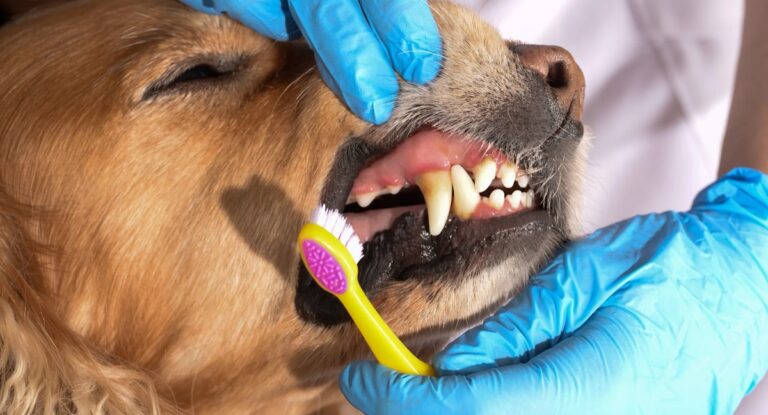
- Canine oral health (halitosis): A 2025 double-blind, placebo-controlled RCT in 24 dogs found that a heat-treated postbiotic combining fermentation products of Pediococcus pentosaceus and Bacillus subtilis reduced volatile sulfur compounds — the chemical basis of bad breath — by 27% versus placebo (p=0.004), with twice as many dogs showing perceptibly improved breath and no adverse events (Sordillo et al., 2025; PMID: 40509062).
- Itching and the gut-skin axis: A 2025 double-blind, placebo-controlled RCT in 30 dogs found that an indole-rich postbiotic reduced scratching by 20% from baseline (p=0.032) and reduced perceived itching by 27% versus placebo (p=0.02), while increasing gut microbiome Shannon diversity by 4.6% (p=0.043) (Sordillo et al., 2025; PMID: 40723482).
- Dental plaque: A 2025 placebo-controlled, double-blind 57-day trial in 60 dogs found that a heat-treated Lactiplantibacillus plantarum postbiotic produced a significant 10% reduction in dental plaque accumulation and modulated the oral microbiome (Florit-Ruiz et al., 2025).
- Gut health (live vs. heat-treated): A 2024 study in the Journal of Animal Science compared live and heat-treated forms of Bifidobacterium animalis subsp. lactis BPL1 in healthy adult dogs and found both were safe and both increased fecal propionate, supporting gut health.
- Immune function in senior dogs: Two related trials (Wambacq et al., 2024 and 2025) found that a prebiotic-plus-postbiotic combination increased the CD4+/CD8+ T-cell ratio (p<0.001) and stabilized the fecal microbiota of older dogs by favoring short-chain-fatty-acid-producing bacteria.
A 2025 systematic review and meta-analysis screened 157 records and analyzed 13 in-vivo canine studies, concluding that while the field is young and heterogeneous, “existing evidence from other species suggests that postbiotics improve the gut microbiota composition, modulate immune and inflammatory responses, reduce oxidative stress, and aid in the treatment of chronic conditions such as atopic dermatitis” (Bonel-Ayuso et al., 2025; PMID: 40732081).
We want to be precise about what we are and are not claiming. We are not claiming that postbiotics are a proven cure for anything, and we note honestly that the 2025 meta-analysis did not find statistically significant differences for some fecal parameters — a sign the evidence base is still maturing. What we are claiming is a matter of public record: a small postbiotic-focused segment has generated more product-level, peer-reviewed, double-blind canine trial evidence than most of the category’s largest sellers. In an industry that markets science while declining to publish it, that is a genuinely anomalous and noteworthy fact.
There is a structural reason for this. A postbiotic-first product cannot hide behind a big CFU number, because it has no live count to advertise. Its marketing claim has to rest on something else — and the most defensible “something else” is a published trial. The postbiotic approach, in a sense, forces a company toward the evidence standard that the rest of the industry avoids. We explore the related transparency implications in our investigation of proprietary blends versus full disclosure.
Why the Gap Persists
If published trials are such a powerful differentiator, why don’t more brands run them? The answer is economic, and it is the heart of this investigation.
1. They are not required to. Because supplements are regulated as food, no agency demands pre-market efficacy proof. The legal floor is zero trials. A brand that runs none faces no penalty; a brand that runs one and gets a null result faces a self-inflicted wound. The rational move, for a company optimizing short-term margin, is to stay ambiguous.
2. They are expensive and slow. A properly powered, double-blind, placebo-controlled canine trial costs tens of thousands of dollars per arm, requires veterinary oversight, an ethics protocol, and months of recruitment and follow-up, and must survive peer review. For a D2C brand whose competitive advantage is speed-to-market and paid-media velocity, a year-long trial is anathema.
3. They are risky. A marketing claim is deniable and flexible. A published trial is permanent and falsifiable. If a brand’s product performs no better than placebo in a rigorous trial — as the 2019 acute-diarrhea probiotic trial found — that result follows the product forever and is citable by every competitor and journalist. For a company whose valuation depends on growth narrative, the downside of testing outweighs the upside.
4. Marketing spend outperforms research spend. In a category where most buyers never read PubMed, a dollar of paid social advertising reliably generates more revenue than a dollar of clinical research. Private-equity-backed brands in particular are engineered for this arbitrage: acquire a brand, scale paid acquisition, optimize subscription lifetime value, and exit. Research is a cost center; advertising is a growth lever. We documented this dynamic in our profile of the subscription supplement economy and in our analysis of who funds pet nutrition research.
Key Finding: The clinical trial gap is not an accident or an oversight. It is the predictable output of a regulatory regime that requires no proof, a capital model that rewards marketing over research, and a consumer base that cannot easily tell the difference between “clinically studied” and “clinically proven.” Follow the money, and the gap explains itself.
What This Means for Consumers
The purpose of this investigation is not to tell you which product to buy. It is to give you a framework for evaluating the claims in front of you. A few principles follow directly from the evidence:
- Demand product-level evidence, not ingredient-level citations. When a landing page cites a study, check whether it tested the finished product, in dogs, at the dose used. If the citation is for a raw ingredient, in humans, you are looking at marketing, not proof.
- Treat “clinically studied” as a weak signal. It is the weakest form of scientific claim a brand can make while still sounding rigorous. “Clinically proven in dogs in a peer-reviewed trial” is a strong signal. The distance between those two phrases is the entire point of this article.
- Be skeptical of precision you cannot verify. A CFU count printed to the billion is only meaningful if the product actually contains it at point of use — and the published record, including the 2011 Weese & Martin analysis finding only 27% of veterinary probiotics met their label claims, suggests many do not.
- Weight the evidence category, not the marketing budget. A small brand with a published double-blind canine RCT has, on the specific question of “does this product work,” stronger evidence than a billion-dollar incumbent with a Super Bowl ad and a white-coated spokesperson.
- Understand the regulatory baseline. No one has verified that the product works before it reached the shelf. The burden of proof, in this market, falls on you. Our consumer guide to verifying supplement claims walks through the practical steps.
The dog supplement industry is not, on the whole, a collection of bad actors. Many of these companies make reasonable products, and some make genuinely good ones. But the industry has collectively decided that the appearance of science is cheaper than the thing itself — and that, in a market with no efficacy floor, the appearance is enough. It is not. Your dog deserves better than a marketing claim dressed in a lab coat.
Frequently Asked Questions
Has any dog supplement brand published a real clinical trial?
Yes, but they are the exception. Purina FortiFlora’s SF68 strain has genuine canine research behind it, and a handful of others (YuMOVE on joint ingredients, Leap Years on longevity, and a cluster of postbiotic-focused trials) have published canine studies. The overwhelming majority of the category’s biggest sellers, however, have no peer-reviewed, product-level randomized trial in dogs on the specific product they sell. When in doubt, search PubMed for the brand name plus “dog” or “canine” and see what comes back.
What does “clinically studied” mean on a supplement label?
It is not a regulated term and has no legal definition. In practice it almost always means that one of the product’s individual ingredients was studied somewhere — frequently in humans or in vitro — not that the finished product was tested in dogs. It is a claim about an input, not the output. A stronger, more meaningful claim would be “clinically proven in a peer-reviewed canine trial,” which very few brands can make.
Why don’t supplement companies just prove their products work?
Because they are not legally required to, because rigorous trials are expensive and slow, and because a published trial carries the risk of a null or negative result that would permanently damage the brand. In a market regulated as food rather than drugs, the economically rational choice for most companies is to spend on marketing that evokes science rather than on research that might disconfirm it.
Are postbiotics better than probiotics?
The honest answer is that the evidence is still maturing, and a 2025 meta-analysis found the canine data heterogeneous with some non-significant results. What can be said on the public record is that postbiotics — being inanimate — avoid the stability and label-accuracy problems that plague live-culture probiotics, and that the postbiotic segment has generated a notable cluster of peer-reviewed canine RCTs in a short period. Whether that translates to superior real-world outcomes for your specific dog is a question to discuss with your veterinarian.
How can I tell if a supplement’s science claims are real?
Trace every cited study to its primary source and ask three questions: Was it conducted in dogs? Was it on the finished product (not just an ingredient)? Was it randomized and placebo-controlled? If the answer to any of those is no, the claim is weaker than it appears. Also check whether the brand discloses full ingredient doses or hides behind proprietary blends, and whether it has any third-party verification — topics we cover in our third-party testing investigation.
Does the FDA approve dog supplements before they are sold?
No. Pet supplements are regulated as food, not drugs, which means there is no pre-market approval process and no requirement to demonstrate efficacy. The FDA’s oversight is complaint-driven and reactive, and its Center for Veterinary Medicine is stretched across a $50B+ market. The practical effect is that the burden of evaluating whether a product works falls on the consumer.
Related Investigations
References
- Jugan MC, Rudinsky AJ, Parker VJ, Gilor C. Use of probiotics in small animal veterinary medicine. JAVMA. 2017;250(5):519-528. PMID: 28207322.
- Weese JS, Martin H. Assessment of commercial probiotic bacterial contents and label accuracy. Can Vet J. 2011;52(1):43-46. PMC3003573.
- Shmalberg J, et al. A Randomized Double Blinded Placebo-Controlled Clinical Trial of a Probiotic or Metronidazole for Acute Canine Diarrhea. Front Vet Sci. 2019;6:163. DOI: 10.3389/fvets.2019.00163.
- Manson-Smith DF, et al. Longitudinal Survey of Fecal Microbiota in Healthy Dogs Administered a Commercial Probiotic. Front Vet Sci. 2021;8:664318. DOI: 10.3389/fvets.2021.664318.
- Salminen S, Collado MC, Endo A, et al. The International Scientific Association of Probiotics and Prebiotics (ISAPP) consensus statement on the definition and scope of postbiotics. Nat Rev Gastroenterol Hepatol. 2021;18:649-667. DOI: 10.1038/s41575-021-00440-6.
- Sordillo A, Casella L, Turcotte R, Sheth RU. A Novel Postbiotic Reduces Canine Halitosis. Animals (Basel). 2025;15(11):1596. PMID: 40509062.
- Bonel-Ayuso DP, et al. Effects of Postbiotic Administration on Canine Health: A Systematic Review and Meta-Analysis. Microorganisms. 2025;13(7):1572. PMID: 40732081.