

The Cold Chain Problem: Why Your Probiotic Might Be Dead Before You Buy It
Our Investigations Desk —
On this page
By Sarah Jennings, Regulatory Correspondent | Published July 30, 2026 | 14 min read
Table of Contents
- The Problem No One Talks About
- Why Live Bacteria Are Fragile
- The Journey From Factory to Food Bowl
- Delivery Method vs. Stability Risk
- The “At Manufacture” Fine Print
- The Postbiotic Alternative
- Our Findings
- Frequently Asked Questions
- References
🔑 Key Takeaways
- A live probiotic is only useful if the bacteria are still alive when your dog eats them. Between the factory and the food bowl, heat, moisture, oxygen, and time kill a large and unpredictable fraction of them.
- The CFU (“colony-forming unit”) count printed on most labels reflects the number of organisms at the time of manufacture — not the number alive at the time of purchase, let alone consumption.
- Independent analyses have repeatedly found commercial veterinary probiotic products falling far short of their label claims — in one review, all eight veterinary products tested contained individual organisms at less than 2% of label claims.
- The industry’s standard workaround is “overfilling” — putting in 1.5 to 4 times the labeled amount to compensate for expected die-off — an admission that the number on the label is not the number in the product.
- Postbiotics — inactivated microorganisms and their components — are inherently more stable, do not depend on a cold chain, and deliver a consistent dose from manufacture to consumption, eliminating this entire class of vulnerability.
The Problem No One Talks About
The number is printed in large, confident type on the front of the package:[1] 30 Billion CFU. It looks like a guarantee. It is, in fact, a snapshot — and a stale one.
That number describes how many live bacteria were in the product at the moment it left the factory. It does not describe how many are alive today, sitting in a warehouse, a delivery truck, or a mailbox in the summer sun. It does not describe how many will survive the journey through your dog’s stomach acid. And it does not describe how many will arrive, alive and active, in the place they are supposed to work.
The core finding of this investigation: The entire value proposition of a live probiotic rests on organisms staying alive across a supply chain that is, by its nature, hostile to them. The published literature shows that a large and unpredictable fraction does not survive — and that the number on the label is frequently not the number in the product[2].
This is the cold chain problem, and it is the single most under-discussed vulnerability in the multi-billion-dollar probiotic segment[6]. It is not a matter of a few bad brands. It is a consequence of the biology of live organisms and the physics of getting a product from a manufacturing floor to a dog in a hot climate. Understanding it changes how you read every probiotic label.
Why Live Bacteria Are Fragile
A probiotic, by definition, contains[3] live microorganisms. That is what distinguishes it from other supplement categories — and it is precisely what makes it fragile. Living cells are sensitive to their environment in ways that, say, a mineral or a vitamin is not.
The peer-reviewed literature identifies four principal killers:
- Heat. Elevated temperature accelerates bacterial die-off. This is the dominant risk in a supply chain that routinely passes through un-air-conditioned warehouses and parked delivery trucks.
- Moisture. Water activity drives degradation. Soft chews — the most popular probiotic format, accounting for the large majority of the market by some estimates — introduce moisture that works against shelf stability.
- Oxygen. Many probiotic strains, including bifidobacteria, are sensitive to oxygen exposure, which degrades them over time[4].
- Time. Even under good conditions, viability declines across a product’s shelf life, which can run 12 to 24 months[5].
The International Scientific Association of Probiotics and Prebiotics (ISAPP) has noted plainly that over a shelf life of 12 to 24 months at room temperature, “a proportion of cells will likely lose viability.” This is not a defect. It is the expected behavior of living things.
The Journey From Factory to Food Bowl
Now follow a bottle of probiotics from the factory to your dog. At each stage, the organisms are exposed to conditions that reduce the count.
Manufacturing
The manufacturing process itself — mixing, drying, compression into chews or tablets — can stress or kill a portion of the culture. Heat generated during processing is a particular concern for live organisms.
Warehousing
Finished goods sit in warehouses that are not, in general, refrigerated. In warm regions and warm months, ambient temperatures inside storage facilities can climb well into the range that accelerates die-off. A product may sit for weeks or months before it ships.
Shipping and last-mile delivery
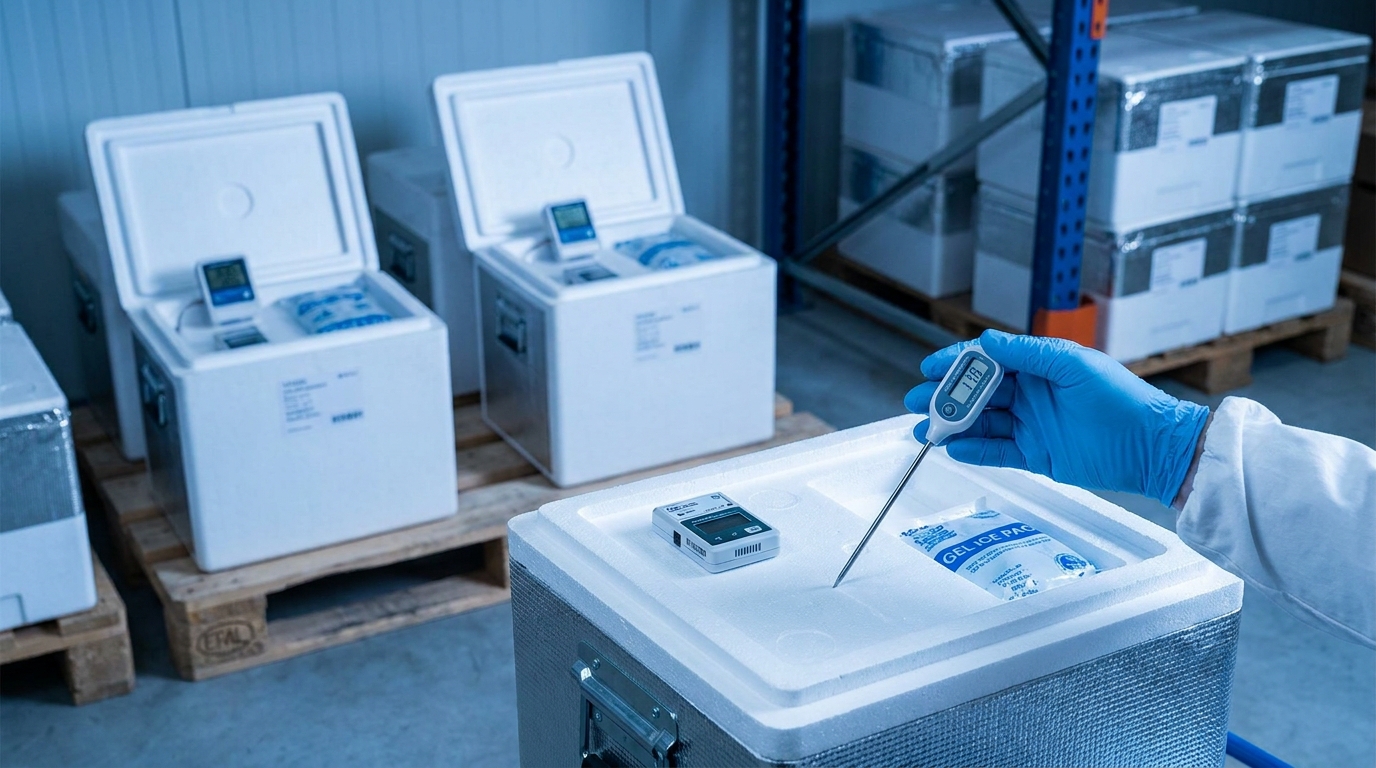
This is where the “cold chain” — the unbroken sequence of temperature-controlled handling that a live product ideally requires — most often breaks. Standard e-commerce shipping is not refrigerated. Packages ride in hot trucks, sit on sun-baked porches, and bake in mailboxes. A product labeled to require refrigeration may spend days in transit without it. Our broader look at how ingredients and products move, our supply chain investigation, documents how little visibility consumers have into these conditions.
The stomach
Even a product that survives the shelf must then survive the dog. Gastric acid is hostile to bacteria. A 2023 study of microencapsulated canine-specific probiotics found that even protected cells showed one- to two-log reductions in viable count after 180 minutes in simulated gastric juice — and unprotected cells fared far worse. In other words, the final gauntlet claims a large share of whatever made it this far.
Delivery Method vs. Stability Risk
Not all delivery methods carry the same risk. The table below summarizes our assessment — an editorial assessment based on the published literature — of the stability risk associated with the principal ways biotics reach a dog.
| Delivery method | Stability risk | Primary vulnerability | Evidence basis |
|---|---|---|---|
| Live probiotic soft chew | High | Moisture + heat during manufacturing and storage | ISAPP shelf-life discussion; moisture-driven degradation literature |
| Live probiotic powder (shelf-stable) | Medium–High | Heat and oxygen over shelf life; no refrigeration | ISAPP; viability-decline reviews |
| Live probiotic requiring refrigeration | Medium–High | Cold chain breaks in shipping and last-mile delivery | Cold-chain dependency; transit-temperature exposure |
| Microencapsulated live probiotic | Medium | Protected, but still viability-dependent; 1–2 log gastric loss reported | ScienceAsia 2023 simulated-gastric study |
| Postbiotic (inactivated) | Low | Inherently stable; no live cells to die; no cold chain required | PMC11321893 (2024); PMC12639491 (2025); Arrioja-Bretón et al. 2020 |
Risk ratings are an editorial assessment based on the cited literature, not the result of our own stability testing. Individual products vary with formulation, packaging, and handling.
The “At Manufacture” Fine Print
Here is the part most consumers miss. When a label prints a CFU count, that number typically reflects potency at the time of manufacture. Some labels specify “at expiration,” but many do not — and the difference can be enormous.
The industry’s standard response to die-off is a practice called overfilling. ISAPP has observed that manufacturers commonly overfill probiotic capsules or sachets with 1.5 to 4 times more live cells than the label states, to compensate for the organisms expected to die during shelf life. Read that again: the number on the label is not the number in the product. The product contains a multiple of the labeled amount at the factory, precisely so that — after expected die-off — something close to the labeled amount might remain later. It is an engineering workaround for a biological problem, and it is an implicit acknowledgment that viability is a moving target.
Independent testing suggests the workaround often falls short. The findings are consistent and sobering:
- A landmark analysis of commercial veterinary probiotics found that only a minority of products with specific CFU claims met or exceeded their label claim, with quality control described as poor (Weese & Martin, 2011).
- A 2017 review in the Journal of the American Veterinary Medical Association reported that products containing live organisms showed actual concentrations “ranging from 0.008% to 215% of the labeled concentrations,” and that all eight veterinary products evaluated in one study “contained concentrations for individual microorganisms that were <2% of label claims” (Jugan et al., 2017).
- An assessment of companion-animal kefir products found that every product with a guaranteed count overstated its microorganisms by at least tenfold (Metras et al., 2020).
Key Finding: The CFU number is the probiotic category’s headline selling point — and it is the metric least likely to be accurate by the time you buy. When independent labs check, the live count frequently bears little resemblance to the label. The number that matters is the number of organisms that arrive alive in your dog’s gut, and no label prints that one.
We examined the broader pattern of labels diverging from actual content in The Dosage Gap. The cold chain problem is that pattern’s biological cause.
The Postbiotic Alternative
There is a structural solution to the cold chain problem, and it is not better refrigeration. It is removing the fragility entirely.
A postbiotic is, per the 2021 ISAPP consensus definition, “a preparation of inanimate microorganisms and/or their components that confers a health benefit on the host” (Salminen et al., 2021). The key word is inanimate. The microorganisms have been inactivated — typically by heat — and what remains are the cell components and metabolites that do the biological work: cell-wall fragments, short-chain fatty acids, peptides, and other bioactive compounds.
Because there are no live cells to keep alive, the entire cold chain problem disappears. The literature is consistent on this point:
- Postbiotics are “more stable than live probiotics, which makes them less sensitive to temperature, light, and pH, making them easy to store and transport” (Hernández-Granados et al., 2024; PMC11321893).
- “Unlike live probiotics, which are sensitive to processing and environmental conditions… postbiotics are inherently more stable as they are composed of inanimate entities. Moreover, postbiotics do not rely on cold chain supply management” (PMC12639491, 2025).
- “Postbiotics do not require refrigeration, can survive heat processing, and pose no risk of infection or microbial imbalance” (PMC12639491, 2025).
- A storage-stability evaluation found that a postbiotic preparation “maintained the highest bioactivity when stored at 15–25°C,” supporting ambient-temperature storage (Arrioja-Bretón et al., 2020).
The practical consequence for a consumer is significant. A postbiotic delivers the same dose from the first sachet to the last, regardless of whether the package sat in a hot warehouse or a cold one. There is no overfilling required to hedge against die-off, because there is no die-off. There is no refrigeration to forget, no cold chain to break, no gamble about how many organisms survived the mailbox in July. The dose on the label is the dose in the product, consistently, across its shelf life.
The consumer product that embodies this stability argument is , whose formula uses a heat-treated (inactivated) postbiotic rather than live cultures — so there is no viable count to decay and no cold chain to break. Our assessment is in the spotlight below.
We want to be precise about what this does and does not establish. Stability is not the same as proven superiority. There are not yet head-to-head trials proving postbiotics outperform probiotics on health outcomes in dogs. What the evidence does establish is that postbiotics remove an entire category of uncertainty — the viability gamble — that live probiotics cannot escape. For a consumer who wants to know that what they are paying for is actually present and consistent, that is a meaningful, literature-supported advantage.
It is also, notably, an advantage that compounds with the others our investigations keep surfacing: the products built on postbiotic science tend to be the same ones that publish canine clinical trials and disclose every dose. The categories travel together. We explore the clinical-evidence side in The Clinical Trial Gap.
⚖️ Our Findings
- The CFU on the label is a snapshot, not a guarantee. It typically reflects potency at manufacture, and a large, unpredictable fraction of live organisms dies before the product reaches your dog.
- The supply chain is hostile to live bacteria. Heat in warehouses and trucks, moisture in soft chews, oxygen exposure, shelf time, and stomach acid all reduce viable counts — and the cold chain breaks routinely in standard e-commerce shipping.
- Independent testing confirms the gap. Multiple analyses have found veterinary probiotic products far below their label claims — in one review, all eight products tested below 2% of label for individual organisms.
- Overfilling is an admission, not a solution. The industry’s practice of adding 1.5–4× the labeled amount concedes that viability is a moving target.
- Postbiotics remove the vulnerability at its root. Inactivated, inherently stable, cold-chain-independent, and consistent dose-to-dose, postbiotics eliminate the viability gamble that defines live probiotics.
The bottom line: A dead probiotic is an expensive placebo. Until you can verify that the organisms in a product are alive at the point of consumption — something no label tells you — you are paying for a number that may no longer exist. The strongest answer the literature offers is to choose a category that does not depend on organisms staying alive at all.
Frequently Asked Questions
Why might a probiotic be dead before I buy it?
Live bacteria are sensitive to heat, moisture, oxygen, and time. Between manufacture, warehousing, shipping, and shelf storage — much of it without refrigeration — a large and unpredictable fraction of the organisms die. The CFU count on the label usually reflects potency at manufacture, not at purchase.
What does “CFU at manufacture” mean?
CFU stands for colony-forming units, a measure of viable bacteria. “At manufacture” means the count reflects how many organisms were present when the product was made. Over a 12- to 24-month shelf life, that number declines, so the count at purchase is typically lower — sometimes far lower — than the printed figure.
What is overfilling, and why do probiotic companies do it?
Overfilling means adding more live organisms than the label states — commonly 1.5 to 4 times as many, according to ISAPP — to compensate for the die-off expected during shelf life. It is an acknowledgment that the labeled number is a target to be reached later, not a description of what is in the product at the factory.
Do postbiotics need to be refrigerated?
No. Because postbiotics contain inactivated microorganisms rather than live cells, they do not rely on a cold chain. The published literature describes them as inherently more stable than live probiotics, resistant to temperature, light, and pH, and suitable for ambient storage.
Are postbiotics proven to work better than probiotics in dogs?
Not directly — there are not yet head-to-head trials proving superiority on health outcomes in dogs. What the evidence does show is that postbiotics eliminate the viability and cold-chain uncertainty inherent to live probiotics, delivering a consistent dose from manufacture to consumption. That is a documented stability advantage, distinct from a claim of clinical superiority.
Related Investigations
References
- Weese JS, Martin H. Assessment of commercial probiotic bacterial contents and label accuracy. Can Vet J. 2011;52(1):43-46. PMC3003573.
- Weese JS. Microbiologic evaluation of commercial probiotics. JAVMA. 2002;220(6):794-797. PMID: 11918274.
- Jugan MC, Rudinsky AJ, Parker VJ, Gilor C. Use of probiotics in small animal veterinary medicine. JAVMA. 2017;250(5):519-528. PMID: 28207322.
- Shmalberg J, et al. A Randomized Double Blinded Placebo-Controlled Clinical Trial of a Probiotic or Metronidazole for Acute Canine Diarrhea. Front Vet Sci. 2019;6:163. DOI: 10.3389/fvets.2019.00163.
- Manson-Smith DF, et al. Longitudinal Survey of Fecal Microbiota in Healthy Dogs Administered a Commercial Probiotic. Front Vet Sci. 2021;8:664318. DOI: 10.3389/fvets.2021.664318.
- Salminen S, Collado MC, Endo A, et al. The International Scientific Association of Probiotics and Prebiotics (ISAPP) consensus statement on the definition and scope of postbiotics. Nat Rev Gastroenterol Hepatol. 2021;18:649-667. DOI: 10.1038/s41575-021-00440-6.