NASC Quality Seal: What It Means and What It Doesn’t
Our Investigations Desk —
On this page
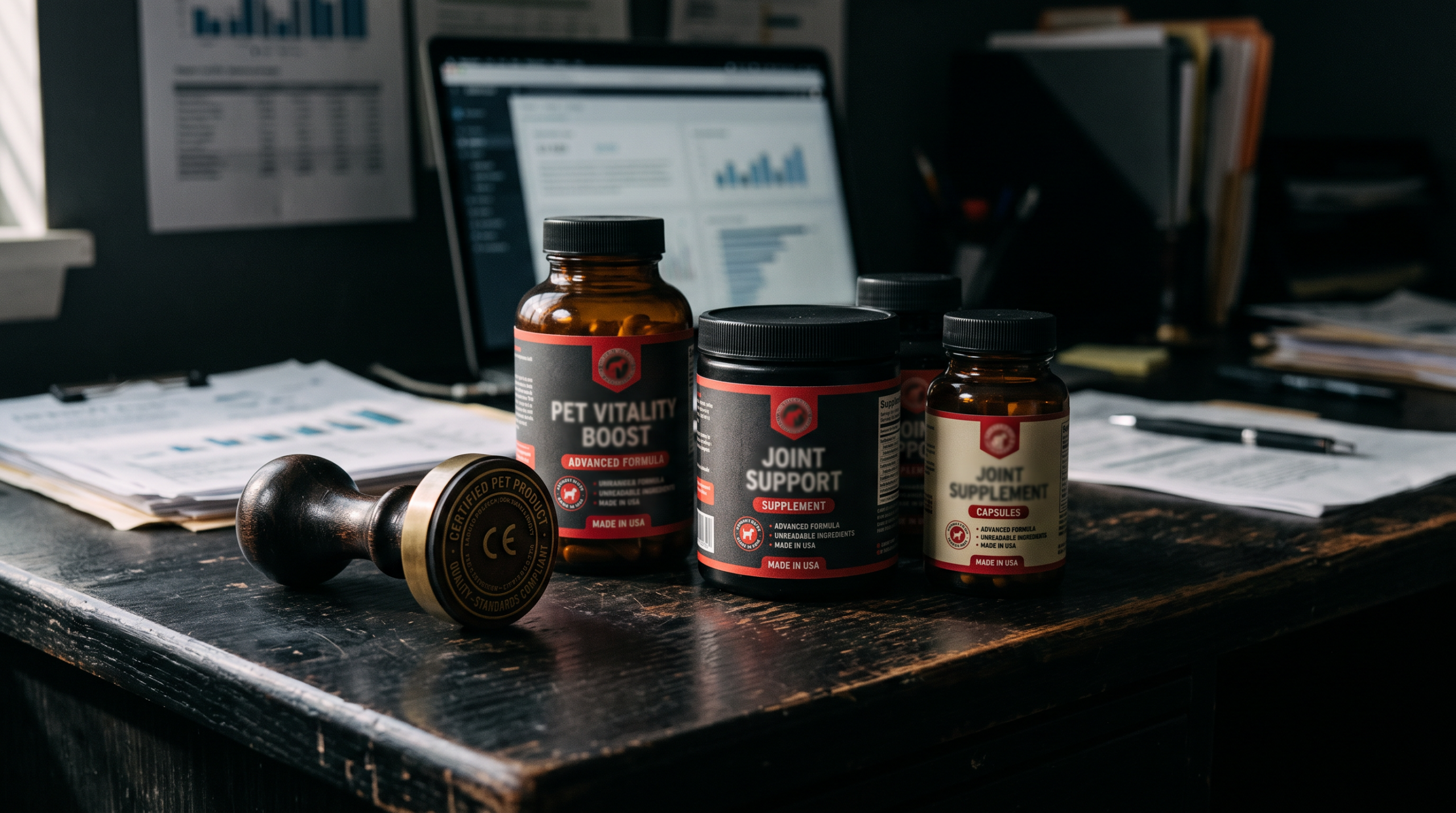
In a market with no mandatory pre-market approval, no universal batch testing, and limited federal enforcement[2], any quality signal carries weight. The NASC Quality Seal — that small blue-and-gold emblem on supplement labels — is the most widely recognized third-party marker in the animal supplement space. Manufacturers display it prominently. Consumers treat it as a proxy for safety and quality.
But what does the seal actually verify? What is the audit process? What is tested, what is not tested, and what gaps remain between the seal’s promise and its practical coverage? This report examines the NASC program with the scrutiny it deserves — neither dismissing it nor accepting it uncritically.
What NASC Is
The National Animal Supplement Council is a trade association founded in 2001[1], headquartered in San Luis Obispo, California. It was established by animal supplement manufacturers seeking to create industry self-regulatory standards in the absence of robust government oversight[3].
Organizational Structure
- Membership: Open to manufacturers, distributors, retailers, and suppliers in the animal supplement industry. Membership requires payment of annual dues (tiered by company revenue).
- Governance: Board of directors elected from member companies. Strategic decisions are made by members, for members.
- Funding: Member dues, event revenue, and program fees. NASC receives no government funding.
- Staff: Approximately 15-20 full-time employees managing programs, audits, and member services.
Stated Mission
NASC’s published mission centers on: protecting and enhancing the animal supplement market, promoting responsible industry practices, facilitating communication between industry and regulators, and providing consumers with quality assurance mechanisms.
The Quality Seal Program: Components
1. Facility Audit
Member manufacturing sites undergo a GMP-based audit conducted by NASC or its designated third-party auditors. The audit covers:
- Sanitation and hygiene: Cleaning protocols, pest control, environmental monitoring.
- Documentation: Batch records, standard operating procedures (SOPs), change control, deviation management.
- Quality control: Incoming raw material testing, in-process controls, finished product release criteria.
- Personnel: Training records, qualification documentation, organizational structure.
- Equipment: Calibration records, maintenance schedules, suitability for intended use.
- Storage and distribution: Temperature control, inventory management, recall procedures.
Audits are conducted at initial membership and periodically thereafter (typically every 2-3 years, with risk-based frequency adjustments). Corrective action requests (CARs) must be addressed within defined timeframes.
2. Adverse Event Reporting (AER)
Members must report adverse events associated with their products to NASC within a defined timeframe[1]. NASC aggregates reports, identifies patterns, and may initiate product investigation if clusters emerge.
- Reporting is mandatory for members (contractual obligation, not legal requirement).
- NASC maintains a database of reported events.
- Serious events (hospitalization, death) trigger expedited review.
- Aggregate data informs industry guidance and regulatory communication.
3. Label Review
NASC reviews member product labels for compliance with its labeling guidelines, which align with AAFCO models and FDA expectations:
- Proper product identity statement
- Net quantity declaration
- Guaranteed analysis format
- Ingredient list in descending order of predominance
- Appropriate claims (structure/function, not disease)
- Required warnings and cautions
- Manufacturer/distributor identification
4. Random Product Testing
NASC conducts periodic blind purchases of member products from retail channels and submits them for laboratory analysis:
- Identity verification: Does the product contain the listed active ingredients?
- Potency verification: Are active ingredients present at labeled amounts (within acceptable variance)?
- Contaminant screening: Heavy metals (lead, arsenic, cadmium, mercury), microbial contamination (Salmonella, E. coli, total aerobic count), mycotoxins where applicable.
Testing frequency and coverage are not publicly specified in detail. NASC reports aggregate compliance rates but does not publish individual product results[5].
What the Seal Verifies
So what can a consumer reasonably take away from the NASC Quality Seal?
- ✓ The manufacturing facility has passed a GMP-based audit.
- ✓ The company has documented quality systems (SOPs, batch records, training).
- ✓ The company participates in adverse event reporting.
- ✓ Product labels have been reviewed for regulatory compliance.
- ✓ The product is subject to random (not systematic) testing for label accuracy and contaminants.
- ✓ The company is a member in good standing of an industry trade organization.
What the Seal Does NOT Verify
This is the critical section. The NASC Quality Seal does not certify:
- ✗ Product efficacy. NASC does not evaluate whether the product produces the claimed health benefit. No clinical trial review. No outcome assessment.
- ✗ Batch-by-batch quality. Testing is random and periodic. Any individual batch may or may not have been tested.
- ✗ Ingredient sourcing. The audit covers manufacturing processes, not the full supply chain back to raw material origin.
- ✗ Marketing claims accuracy. Label review covers format and regulatory compliance, not whether “supports immune health” is substantiated by evidence.
- ✗ Comparative quality. The seal is binary (member/non-member). It does not rank products or indicate relative quality within the member pool.
- ✗ Continuous compliance. Between audits (2-3 year intervals), conditions can change. The seal reflects a point-in-time assessment.
- ✗ Government approval. NASC is a private trade association. The seal carries no regulatory weight.
Structural Limitations
Voluntary Participation
The most fundamental limitation: NASC membership is voluntary. A manufacturer can produce and sell pet supplements without any NASC involvement. The seal covers only members — a subset of the market. Non-member products face no NASC oversight whatsoever.
The proliferation of DTC brands, Amazon-only sellers, and international imports means that a significant and growing portion of the market operates outside NASC’s purview.
Industry Self-Regulation
NASC is funded by the companies it audits. This creates a structural tension:
- Members pay dues and expect value in return. Aggressive enforcement (public failures, membership revocation) risks alienating the funding base.
- The board comprises member company representatives. Governance decisions reflect industry interests.
- There is no external accountability mechanism (government oversight, consumer representation on the board, independent funding).
This does not mean NASC is ineffective or corrupt. It means the program’s design inherently balances quality assurance against member retention. The most stringent enforcement actions (public naming, expulsion) are rare.
Testing Coverage
Random testing, by definition, does not cover every product or every batch. The statistical probability that any specific product on a consumer’s shelf has been NASC-tested is low. The program’s value is primarily deterrent (members know they might be tested) rather than comprehensive verification.
No Efficacy Assessment
This is the gap most relevant to consumers. A product can bear the NASC seal, pass all audits, test clean for contaminants, and still be clinically useless. The seal verifies that the product contains what it claims. It does not verify that what it claims is worth taking.
A supplement containing accurately labeled, contaminant-free, completely ineffective ingredients at sub-therapeutic doses would pass NASC review without issue.
How NASC Compares to Other Certification Programs
| Program | Type | Scope | Efficacy Review? | Batch Testing? |
|---|---|---|---|---|
| NASC Quality Seal | Industry trade association | Facility audit + random testing + AER | No | Random only |
| NSF International | Independent standards organization | Product certification + facility audit | No | Per certification protocol |
| ConsumerLab.com | Independent testing (subscription) | Product testing + label verification | Limited (ingredient evidence review) | Per test cycle |
| USP Verified | Independent pharmacopeia | Product + facility + ongoing monitoring | No | Yes (per protocol) |
| FDA (animal supplements) | Government (reactive) | Post-market enforcement only | No | Complaint-driven only |
What Consumers Should Do With This Information
- Treat the NASC seal as a positive signal, not a guarantee. It indicates the manufacturer has invested in quality systems beyond the regulatory minimum. That is meaningful. But it is not sufficient.
- Layer additional verification. NASC + third-party COA + published clinical evidence + transparent sourcing = a more complete quality picture than any single marker.
- Do not use the seal as the sole decision criterion. A product without the NASC seal may still be excellent (particularly if it holds NSF or USP certification, or publishes independent lab results). A product with the seal may still be clinically unproven.
- Ask what the seal does not answer. “Is this product NASC-certified?” is a valid question. “Does NASC certification mean this product will help my dog?” is a question the seal cannot answer.
The Bottom Line
The NASC Quality Seal is the best voluntary quality marker available in the animal supplement market. In a regulatory environment with no mandatory pre-market review, its existence is valuable. Manufacturers who participate demonstrate a commitment to quality systems that non-members do not.
But the seal’s scope is narrower than consumer perception suggests. It verifies process, not outcomes. It confirms what is in the product, not whether what is in the product works. It covers members, not the market. And it operates within the structural constraints of industry self-regulation: funded by members, governed by members, accountable primarily to members.
The informed consumer treats the NASC seal as one data point in a multi-factor evaluation — necessary, perhaps, but never sufficient. The question is not “does it have the seal?” The question is “what does the seal tell me, and what do I still need to know?”
Frequently Asked Questions
What does the NASC Quality Seal certify?
The NASC Quality Seal certifies that a manufacturer has passed a facility audit (GMP-based), participates in adverse event reporting, complies with NASC labeling guidelines, and is subject to random product testing. It verifies process compliance. It does NOT certify product efficacy, clinical benefit, or batch-by-batch purity.
Is the NASC a government agency?
No. The National Animal Supplement Council is a private trade association funded by member dues. It has no regulatory authority, no enforcement power, and no government mandate. Its seal is a voluntary industry certification, not a government approval.
What percentage of the market does NASC cover?
NASC membership represents a minority of the total pet supplement market. While members include many well-known brands, the proliferation of DTC startups, private-label products, and international imports means that the majority of SKUs on the market are not NASC-certified.
Does NASC test for efficacy?
No. NASC does not evaluate whether a product works as claimed. Its testing program verifies label accuracy and screens for contaminants. Clinical efficacy — whether the ingredients at the included doses produce the claimed health benefit — is outside NASC’s scope.
Related Investigations
References
- National Animal Supplement Council “NASC Quality Seal Program.” nasc.cc. Accessed 2026.
- U.S. Food and Drug Administration “Dietary Supplements.” fda.gov. Accessed 2026.
- Association of American Feed Control Officials “Human Grade Pet Food Claim FAQs.” aafco.org. Accessed 2026.
- U.S. Federal Trade Commission “FTC Endorsement Guides: What People Are Asking.” ftc.gov. Accessed 2026.
- Weese JS, Martin H. Assessment of commercial probiotic bacterial contents and label accuracy. Can Vet J. 2011;52(1):43-46. PMC3003573.