The “Made in USA” Loophole in Pet Supplements
Our Investigations Desk —
On this page
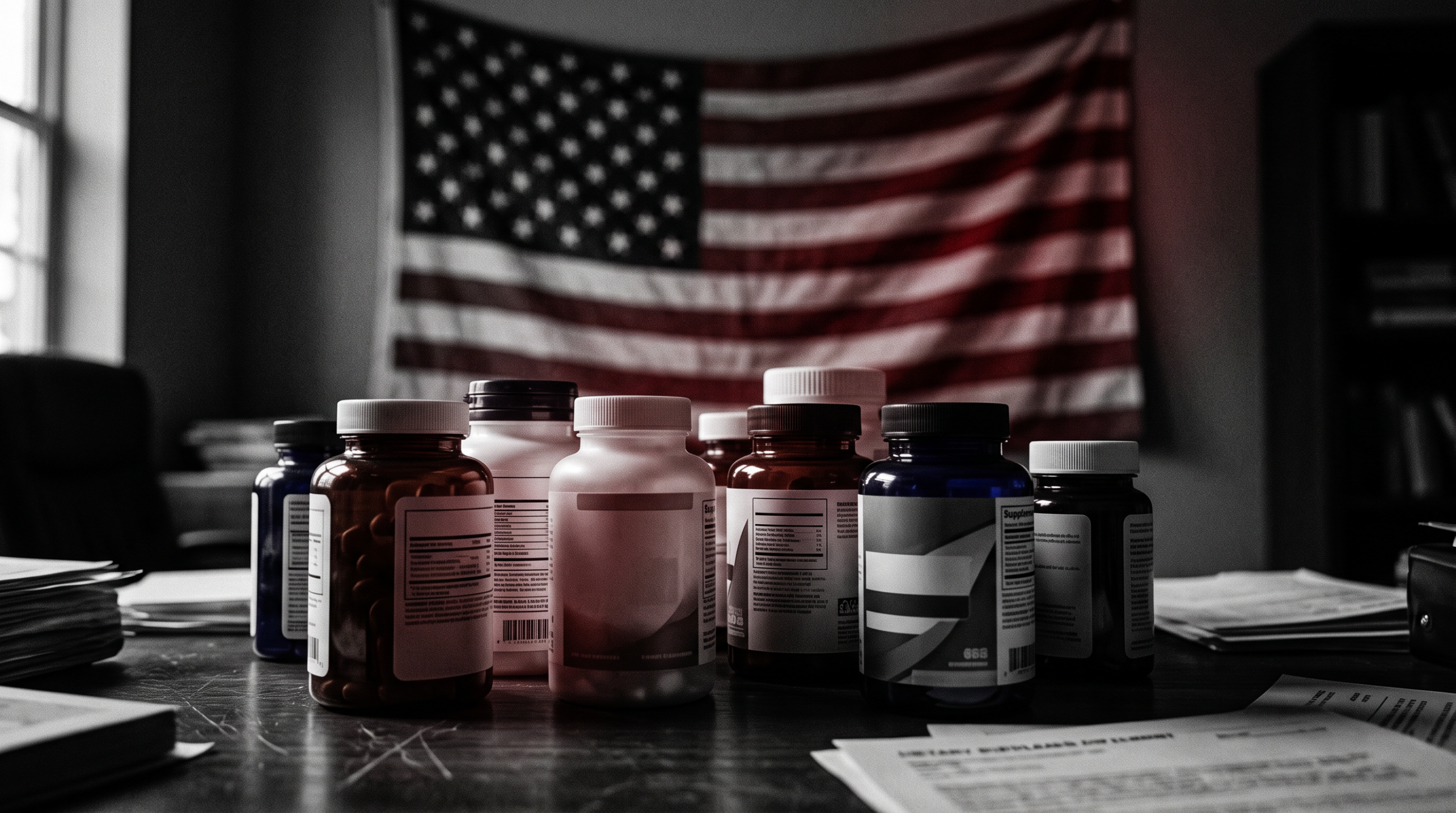
The American flag on the label. “Proudly Made in the USA” in bold type. The stars-and-stripes packaging. For many consumers, these signals communicate quality, safety, and domestic accountability. The product was made here, under American standards, by American workers, subject to American oversight.
For pet supplements, that communication is often technically accurate and substantively misleading. “Made in USA” typically refers to the location of final manufacturing — blending, encapsulation, tableting, packaging. It says nothing about where the active ingredients originated. And for a significant portion of the supplement supply chain, the answer is: not the United States.
This is not a scandal. It is a structural feature of globalized ingredient sourcing, operating within the boundaries of FTC labeling rules. But the gap between what consumers infer from “Made in USA” and what the phrase actually guarantees is wide enough to drive a supply chain through.
The Legal Standard
FTC “Made in USA” Requirements
The Federal Trade Commission administers the[1] “Made in USA” standard under Section 5 of the FTC Act. The standard requires that a product be “all or virtually all” made in the United States. The FTC evaluates:
- The proportion of U.S. manufacturing costs
- How far removed any foreign content is from the finished product
- Where the product’s “substantial transformation” occurs
The “Substantial Transformation” Principle
Under U.S. customs and trade law, a product’s country of origin is determined by where it undergoes “substantial transformation” — the point at which raw materials become a new and different article of commerce. For supplements:
- Importing raw vitamin C powder from China → U.S. origin: China
- Blending that powder with other ingredients, encapsulating, and packaging in a Utah facility → U.S. origin: United States
The blending and encapsulation constitute substantial transformation. The product is, legally, “Made in USA.” The fact that 70-90% of the raw material cost is imported does not change the legal determination[1].
Qualified vs. Unqualified Claims
The FTC distinguishes:
- Unqualified “Made in USA”: Implies all or virtually all content is domestic. Requires that foreign content be negligible.
- Qualified claims: “Made in USA from imported ingredients” or “Assembled in USA from foreign components.” These are more accurate but less common in marketing because they undermine the patriotic appeal.
In practice, many supplement companies use unqualified “Made in USA” claims while sourcing the majority of active ingredients internationally. The FTC’s enforcement attention is focused on higher-profile consumer goods (automobiles, appliances, textiles). Pet supplements rarely attract scrutiny.
The Ingredient Supply Chain: A Global Map
Where Key Supplement Ingredients Originate
| Ingredient | Primary Global Source | U.S. Domestic Production |
|---|---|---|
| Vitamin C (ascorbic acid) | China (~90% of global supply) | Minimal |
| Vitamin B-complex | China, India | Limited |
| Glucosamine HCl/sulfate | China (shellfish-derived), India | Very limited |
| Chondroitin sulfate | China (bovine/shark cartilage) | Very limited |
| Turmeric/curcumin extract | India (~80% of global supply) | Minimal |
| L-theanine | China, Japan | Minimal |
| Omega-3 fish oil | Norway, Peru, Chile, Iceland | Limited (Alaska) |
| Probiotic cultures | Denmark (Chr. Hansen), U.S. (DuPont/IFF), Italy | Significant (but strain-specific) |
| MSM (methylsulfonylmethane) | China, U.S. | Moderate |
| Biotin | China, Switzerland (DSM) | Limited |
The Pattern
For a typical canine joint supplement containing glucosamine, chondroitin, MSM, vitamin C, and turmeric: four of five active ingredients are most likely sourced from China or India. The product is blended, encapsulated, and packaged in a U.S. facility. The label reads “Made in USA.”
This is legal. It is also the industry norm. The U.S. does not have domestic production capacity for most raw supplement ingredients at commercial scale. Decades of chemical manufacturing offshoring have left the domestic supply chain dependent on Asian production for commodity vitamins, amino acids, and botanical extracts.
The Verification Gap
What “Made in USA” Does Not Tell You
- Where raw ingredients were synthesized, extracted, or harvested
- What quality standards governed their production
- Whether they were tested for contaminants at origin
- Whether they were adulterated or diluted before export
- What intermediaries handled them between factory and U.S. blender
- Whether documentation (COAs, allergen statements, GMO status) is authentic
The COA Problem
A Certificate of Analysis (COA) from the ingredient supplier is the primary quality document. But:
- COAs from overseas suppliers are not independently verified by default.
- Document fraud — fabricated or altered COAs — has been documented in FDA import alerts and pharmaceutical supply chain investigations[3].
- U.S. manufacturers are expected to verify incoming materials through identity testing, but the depth of testing varies. Some test only identity (is this glucosamine?); fewer test full purity (is this glucosamine free of heavy metals, pesticides, and residual solvents?).
- The FDA’s Foreign Supplier Verification Program (FSVP) applies to food imports but its application to supplement raw materials is inconsistent[2].
Heavy Metal Concerns
Ingredients sourced from regions with less stringent environmental regulation carry elevated heavy metal risk:
- Lead: Botanical extracts (turmeric, ashwagandha) from regions with lead-contaminated soil or adulteration practices.
- Arsenic: Rice-derived ingredients, seaweed-based minerals, and some traditional herbal preparations.
- Cadmium: Shellfish-derived glucosamine, cocoa-based ingredients.
- Mercury: Fish oil from contaminated waters (less relevant for molecularly distilled products).
FDA import alerts have detained shipments of supplement ingredients for heavy metal exceedances. But import screening covers a fraction of incoming shipments. The majority enter without physical inspection.
Why Companies Use “Made in USA”
Consumer Perception
Market research consistently shows that “Made in USA” is among the top purchase drivers for health products[5]. Consumers associate domestic manufacturing with:
- Higher safety standards
- Better quality control
- Greater accountability (legal recourse, regulatory oversight)
- Environmental responsibility
- Support for domestic employment
These associations are partially valid for the manufacturing step. U.S. GMP facilities are generally well-regulated and audited. But consumers extend the “Made in USA” inference backward through the entire supply chain — to ingredient sourcing, raw material quality, and origin-country oversight — where the association may not hold.
Competitive Necessity
When competitors display “Made in USA” prominently, omitting the claim creates a perceived disadvantage. The result is an industry-wide adoption of the claim, regardless of ingredient sourcing reality. The phrase becomes table stakes rather than differentiator.
What Transparent Sourcing Looks Like
Some companies go beyond the legal minimum:
- Full country-of-origin disclosure: Listing the source country for each active ingredient on the label or website.
- Supplier qualification documentation: Publishing or providing upon request the audit status of raw material suppliers.
- Batch-specific COAs: Making independent lab results available for each production batch, covering identity, potency, and contaminants.
- Third-party supply chain audits: Engaging independent firms to verify ingredient sourcing claims.
- Domestic sourcing where feasible: Prioritizing U.S.-produced ingredients (e.g., U.S.-sourced fish oil, domestic probiotic cultures) and disclosing when import is necessary.
These practices are not required by regulation. They represent voluntary transparency that goes beyond what “Made in USA” communicates.
Questions to Ask Manufacturers
- What is the country of origin for each active ingredient in this product?
- Do you test incoming raw materials beyond identity verification? (Full heavy metal panel, pesticide screen, microbial count?)
- Can you provide batch-specific COAs from an ISO 17025-accredited laboratory?
- Who are your raw material suppliers? Are they GMP-audited?
- Do you conduct on-site supplier audits, or rely solely on documentation?
- Has any batch ever failed incoming inspection? What was the disposition?
A transparent manufacturer will answer these questions. A manufacturer that responds with “all ingredients are rigorously tested” without specifics, or “proprietary sourcing” without documentation, is telling you the supply chain is not as controlled as the marketing suggests.
The Bottom Line
“Made in USA” on a pet supplement label is a manufacturing claim, not a sourcing claim. It tells you where the powder was blended and the capsule was filled. It does not tell you where the powder came from, what standards governed its production, or whether it was verified before it entered the U.S. supply chain.
This is not illegal. It is not necessarily unsafe. But it is a gap between consumer expectation and labeling reality — a gap that the industry has no financial incentive to close and that regulators have limited resources to police.
The consumer who cares about ingredient origin must ask. The label will not volunteer the information. “Made in USA” answers a question most consumers are not actually asking. The question they should be asking — “where did the ingredients come from, and who verified them?” — remains, for most products, unanswered.
Frequently Asked Questions
What does “Made in USA” legally mean for pet supplements?
The FTC’s “Made in USA” standard requires that “all or virtually all” of a product be of U.S. origin. However, the standard is applied to final assembly/manufacturing rather than raw ingredient sourcing. A product manufactured in a U.S. facility using predominantly imported ingredients may still display “Made in USA” if substantial transformation occurs domestically.
Where do pet supplement ingredients actually come from?
A significant portion of raw supplement ingredients are sourced internationally. China is the dominant source for vitamins, amino acids, and glucosamine. India supplies turmeric and herbal extracts. European sources provide some specialty ingredients. Final blending and encapsulation often occurs in U.S. facilities.
Are imported supplement ingredients unsafe?
Not inherently. Many imported ingredients meet or exceed U.S. quality standards. However, supply chain opacity makes verification difficult. Without batch-specific COAs from accredited laboratories, consumers cannot confirm that imported raw materials are free of contaminants. The risk is not origin — it is verification.
How can I find out where a supplement’s ingredients are sourced?
Ask the manufacturer directly. Request: country-of-origin for each active ingredient, supplier qualification documentation, and batch-specific COAs from ISO 17025-accredited laboratories. Companies with transparent supply chains will provide this information. Refusal or vague answers indicate opacity.
Related Investigations
References
- U.S. Federal Trade Commission “Complying with the Made in USA Standard.” ftc.gov. Accessed 2026.
- U.S. Food and Drug Administration “Dietary Supplements.” fda.gov. Accessed 2026.
- U.S. Food and Drug Administration “Warning Letters.” fda.gov. Accessed 2026.
- U.S. Government Accountability Office “Reports and Testimonies.” gao.gov. Accessed 2026.
- Association of American Feed Control Officials “Human Grade Pet Food Claim FAQs.” aafco.org. Accessed 2026.