The Oral Health Blind Spot: Why 90% of Dog Supplements Completely Ignore the Mouth
Our Investigations Desk —
On this page
By The DSR Investigations Desk | Published July 30, 2026 | Updated July 30, 2026 | 15 min read
Table of Contents
- Our Investigation
- The Count: How Many Supplements Address the Mouth?
- The Oral-Gut Axis: Why the Mouth Matters
- What Currently Exists for Canine Oral Health
- The Evidence Gap — and the One Exception
- Why the Industry Ignores the Mouth
- What This Means for Dog Owners
- Frequently Asked Questions
- References
🔑 Key Findings
- Of the top-selling dog supplements across the major categories — gut health, joints, calming, skin, multivitamins, longevity — only a small fraction address oral health in any form, despite the mouth being the entry point to the entire digestive tract.
- The products that do target the mouth are overwhelmingly mechanical (dental chews) or chemical-maskant (water additives), and the vast majority have no peer-reviewed canine efficacy trial behind them.
- The oral microbiome is not separate from gut health; oral dysbiosis seeds gut dysbiosis, and both drive systemic inflammation. Ignoring the mouth while supplementing the gut is addressing the downstream symptom while ignoring the upstream source.
- The only published, peer-reviewed, double-blind, placebo-controlled canine RCTs we identified that directly target oral-health outcomes (halitosis and plaque) both use a postbiotic approach — not a live probiotic, a water additive, or a dental chew.
- The oral-health blind spot is not an oversight; it reflects the economic structure of a market that rewards easy-to-market single-benefit products over harder-to-prove multi-system[5] formulations.
Our Investigation
The dog supplement industry organizes itself into neat, marketable categories. Gut health. Joints and mobility. Calming and anxiety. Skin and coat. Immune support. Longevity. Walk the aisle or scroll the category pages, and you will find a product for nearly every organ system a dog possesses.
Nearly every. One system is conspicuously absent from the “wellness” conversation, despite being the literal front door to the digestive tract that so many of these products claim to support: the mouth.
This struck us as odd enough to investigate systematically. We surveyed the top-selling dog supplements across the major categories and asked: how many of them address oral health in any meaningful way? And for the handful that do, what is the evidence that they actually work? The answers reveal a category-wide blind spot — and, unexpectedly, point to the one corner of the market that has actually done the science.
Key Finding: The supplement industry treats the digestive tract as if it begins at the stomach. It does not. It begins at the mouth. A market that sells billions of dollars of “gut health” products while almost entirely ignoring the oral microbiome is, from a biological standpoint, mopping the floor while the faucet is still running.
The Count: How Many Supplements Address the Mouth?
We reviewed the best-selling and most heavily marketed dog supplements across the dominant categories, drawing on retail bestseller lists, market-share reporting, and the product lineups of the industry’s largest brands. We then classified each product by whether it made any genuine oral-health claim — beyond the incidental “freshens breath” language that appears on some general formulas as a marketing afterthought.
The result was stark. The overwhelming majority of top-selling supplements target the gut, the joints, the skin, or behavior. Products that meaningfully address the oral cavity are a tiny minority, and they cluster in just two formats: dental chews and water additives. The comprehensive “all-in-one” wellness formulas that dominate the D2C marketing space almost never include an oral-health component, despite routinely claiming to support “whole-body wellness.”
| Supplement Category | Addresses Oral Health? | Typical Format | Published Canine Oral-Health RCT? |
|---|---|---|---|
| Gut health / probiotics | Rarely (gut only, not oral) | Chew, powder, capsule | Generally no (and see our trial-gap investigation) |
| Joint / mobility | No | Chew, tablet | N/A (different system) |
| Calming / anxiety | No | Chew, oil | N/A |
| Skin & coat | No | Chew, oil | N/A |
| Multivitamin / all-in-one | Rarely (usually absent) | Chew, powder | Generally no |
| Dental chews | Yes (mechanical) | Chew / treat | Some mechanical-abrasion data; limited microbiome evidence |
| Water additives | Yes (chemical / maskant) | Liquid | Sparse; mostly breath-masking, not microbiome modulation |
| Postbiotic oral formulations | Yes (microbiome-targeted) | Powder / additive | Yes — the only double-blind canine oral RCTs we identified |
The pattern is clear. The mouth is served, to the extent it is served at all, by two legacy formats — the chew you hand your dog and the liquid you pour in the water bowl. The modern supplement industry, for all its “whole-body wellness” branding, has largely declined to treat the oral cavity as part of the system it claims to support.
The Oral-Gut Axis: Why the Mouth Matters
To understand why this blind spot matters, you have to understand that the mouth and the gut are not separate compartments. They are continuous. The oral cavity is the first and most densely populated microbial habitat of the digestive tract, and the bacteria that live there do not stay there.
Dogs, like humans, swallow their oral microbiome continuously. The bacteria that colonize the teeth, gums, and tongue are transported in saliva to the stomach and intestines, where they can influence the composition and function of the gut microbiome. When the oral microbiome is in a healthy, balanced state, this is benign or beneficial. When it is in dysbiosis — dominated by pathogenic, inflammation-driving species — the gut receives a constant inoculum of trouble.
This is the oral-gut axis, and the research literature supports it[1]. Oral pathobionts have been detected in the gut and associated with intestinal inflammation[2] in both human and animal studies. The mechanism is intuitive: a dog with significant oral dysbiosis, plaque biofilm, and periodontal inflammation is, effectively, seeding its own gut with inflammatory bacteria every time it swallows. Supplementing that dog’s gut with a probiotic while leaving the oral source unaddressed[6] is a bit like bailing water out of a boat without plugging the hole.
The downstream consequences are not trivial. Chronic oral inflammation and the dysbiosis that accompanies it are associated, in the broader veterinary and medical literature, with systemic inflammatory burden. Periodontal disease — which affects a large majority of dogs by middle age — is not merely a cosmetic or breath problem; it is a chronic inflammatory condition with documented associations to organ health. Yet the supplement industry’s response to this near-universal condition is, overwhelmingly, a breath-freshening water additive or a dental chew.
Key Finding: The mouth is the upstream source of much of what the gut-health supplement industry claims to treat downstream. A “whole-body wellness” product that ignores the oral microbiome is ignoring the entry point of the very system it markets itself as supporting. The blind spot is not a small omission; it is a conceptual one.
What Currently Exists for Canine Oral Health
To be fair to the market, products marketed for canine oral health do exist. We categorized them by mechanism, because the mechanism determines what the product can and cannot do.
1. Dental chews and treats (mechanical)
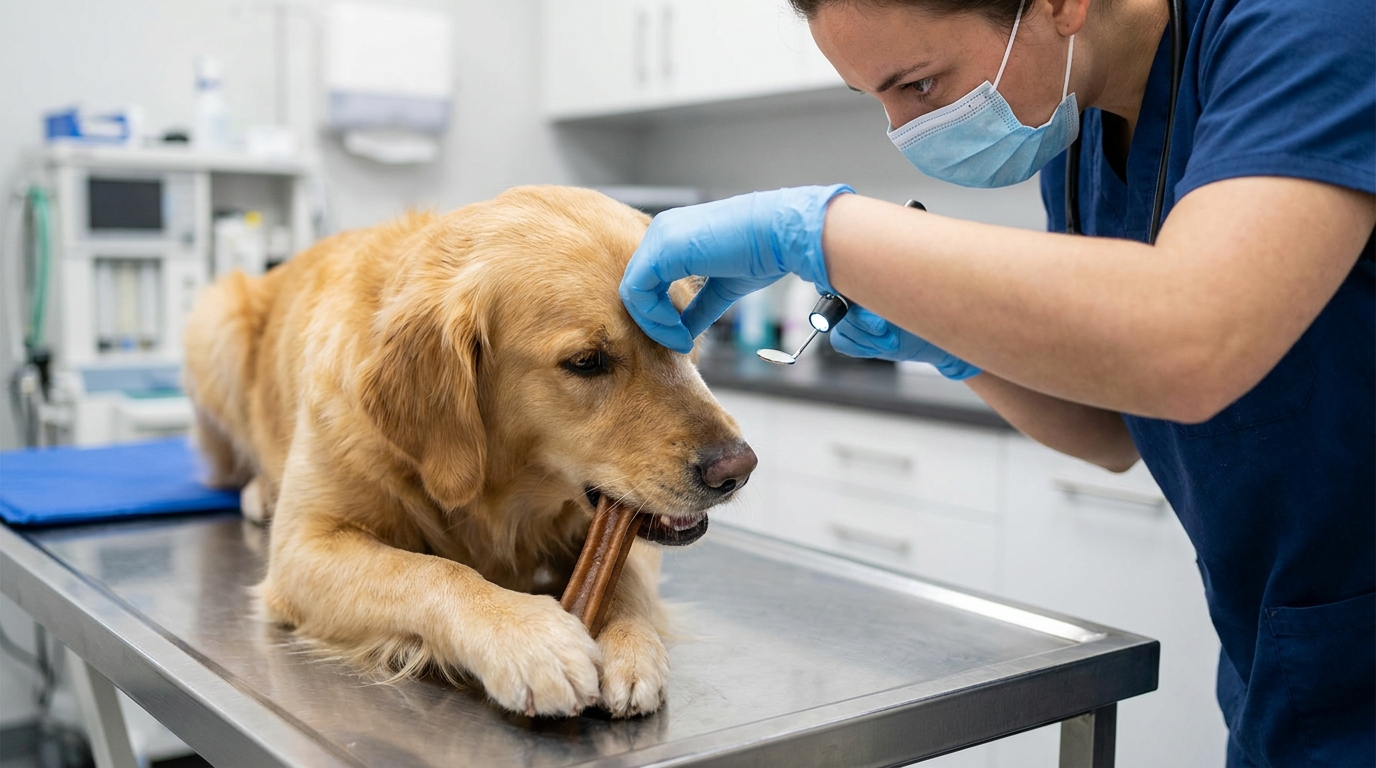
Dental chews work primarily through mechanical abrasion: the act of chewing physically disrupts and removes some plaque from the tooth surface. This is a real and useful mechanism, and veterinary dental organizations recognize that certain chews can reduce plaque and tartar accumulation to a degree. But mechanical action has limits. It addresses the plaque that is physically reachable and removable by chewing; it does not modulate the underlying oral microbiome, and it does nothing for the bacteria colonizing surfaces the chew never touches. It is a hygiene measure, not a microbiological intervention.
2. Water additives and oral rinses (chemical / maskant)
Water additives typically work through one or more of: antimicrobial agents that reduce bacterial load, odor-neutralizing chemistry that addresses the volatile sulfur compounds (VSCs) responsible for bad breath, or enzymes. Some reduce bacteria broadly; many primarily mask or neutralize odor. The distinction matters: neutralizing the smell of dysbiosis is not the same as resolving the dysbiosis. And the evidence base for most water additives is thin[4] — breath-freshening is easy to market and easy to perceive, so it sells without rigorous proof. Few water additives have a peer-reviewed, placebo-controlled canine RCT demonstrating a durable change in oral-health outcomes.
3. Enzymatic and probiotic oral products (biological)
A smaller category attempts a biological intervention — introducing beneficial bacteria or enzymes to the oral cavity to compete with or inhibit pathogenic species. This is the most mechanistically promising approach, because it targets the microbiome rather than the symptom. But it is also the hardest to execute and to prove, and historically it has been under-invested relative to its potential. Live oral probiotics face the same stability and colonization challenges as gut probiotics[3], compounded by the harsh, competitive environment of the mouth.
The common thread across the first two categories — the ones that dominate the market — is that they address the symptom (plaque you can scrape, odor you can mask) rather than the system (the oral microbiome in dysbiosis). The third category aims at the system, but until recently it has lacked the evidence to command the market’s attention.
The Evidence Gap — and the One Exception
Here the investigation arrives at its most striking finding. We searched the peer-reviewed literature for randomized, controlled canine trials targeting oral-health outcomes — halitosis, plaque, gingival inflammation, oral microbiome composition. The pickings were slim across the legacy formats. And then we found the exception.
The published canine oral-health RCTs we identified that directly target the oral microbiome both use a postbiotic approach — inactivated microbial preparations, not live cultures, water additives, or chews:
- Halitosis (bad breath): A 2025 double-blind, placebo-controlled RCT in 24 dogs found that a heat-treated postbiotic combining fermentation products of Pediococcus pentosaceus and Bacillus subtilis reduced volatile sulfur compounds — the chemical basis of bad breath — by 27% versus placebo (p=0.004). By Day 7, VSCs were reduced 22% from baseline (p=0.002), and twice as many dogs in the postbiotic group had perceptibly improved breath. There were no adverse events (Sordillo et al., 2025; PMID: 40509062). Critically, this was not a masking effect; the intervention targeted the microbial root causes of odor production.
- Dental plaque and the oral metagenome: A 2025 placebo-controlled, double-blind 57-day trial in 60 dogs found that a heat-treated Lactiplantibacillus plantarum postbiotic produced a significant 10% reduction in dental plaque accumulation between Day 29 and Day 57 in the high-dose group, with a non-significant trend toward a 17% reduction in the low-dose group. The postbiotic also modulated the oral microbiome, increasing genes associated with denitrification, heme/catechol biosynthesis, and oxidative-stress reduction (Florit-Ruiz et al., 2025). This is a microbiome-level intervention with a measurable structural outcome — not a mask, not a scrape.
We want to be precise and honest about the state of this evidence. Two trials, however well-designed, do not constitute a settled science. The halitosis trial was small (24 dogs), and the field of postbiotic oral health is young. A rigorous consumer should treat these as promising, peer-reviewed, product-level evidence — which is more than can be said for most of the oral-health market — rather than as definitive proof. What makes them remarkable is not that they are the final word, but that they are, to our knowledge, close to the only words: peer-reviewed, double-blind, placebo-controlled canine trials targeting oral-health outcomes through microbiome modulation.
Key Finding: In a market full of breath-freshening water additives and plaque-scraping chews, the only published double-blind, placebo-controlled canine RCTs we identified that target the oral microbiome both use a postbiotic approach. The segment of the market with the least marketing noise has, on this specific question, the most rigorous evidence. That inversion should give every consumer pause.
Why postbiotics, specifically? The mechanism is instructive. A postbiotic is an inanimate microbial preparation — it does not need to colonize the mouth or survive as a live organism in one of the body’s most competitive microbial environments. It works by modulating the existing microbiome and its metabolic output, rather than by trying to establish a new live population. That makes it mechanistically well-suited to the oral cavity, and it makes the results — a reduction in odor-producing VSCs and a measurable shift in plaque-forming biofilm — coherent with the biology. We covered the broader postbiotic evidence base, and why this small segment out-publishes the giants, in our investigation of the clinical trial gap.
Why the Industry Ignores the Mouth
If the oral-gut axis is real and the evidence for microbiome-targeted oral care is emerging, why does the supplement industry largely ignore the mouth? The answer, as usual, is economic rather than scientific.
The one all-in-one product we found that actually targets this oral-health gap with published canine data is , built on the Canine Oral Health Postbiotic. Our full assessment is in the spotlight below.
1. Breath is easy to market; the microbiome is hard. “Freshens breath” is a claim a consumer can verify in ten seconds by smelling their dog. “Modulates the oral metagenome to reduce pathobiont load” is not. The market rewards the claim that is easy to perceive and easy to sell, and breath-freshening is the easiest claim in pet care. There is little commercial incentive to invest in the harder, slower, more expensive work of proving a microbiome outcome.
2. Dental chews and water additives are cheap to make and hard to disprove. A chew is a treat with a dental claim; a water additive is flavored chemistry. Neither requires a clinical trial to bring to market, and both benefit from the placebo-by-proxy effect of an owner who believes they are doing something. In a market with no efficacy floor, the cheap, unproven option out-competes the expensive, proven one. We examined this dynamic in our analysis of the regulatory gap.
3. Category silos discourage systems thinking. The supplement market is organized into single-benefit categories — a joint chew, a calming chew, a gut chew. Oral health does not fit neatly into a single-benefit SKU, and a genuine oral-systemic product implies a multi-system formulation that is harder to market and harder to prove. The industry’s category structure actively selects against the kind of integrated thinking the oral-gut axis demands.
4. Proving it is expensive and risky. A double-blind, placebo-controlled canine oral-health trial costs real money, takes months, and might return a null result. For a brand whose competitive advantage is speed and paid-media velocity, the rational move is to sell a breath-freshening additive with a before-and-after testimonial rather than to fund a trial. The companies that have run these trials are, notably, not the category’s biggest spenders on advertising.
What This Means for Dog Owners
The practical implications for a dog owner are concrete:
- Treat “freshens breath” as a cosmetic claim, not a health claim. Neutralizing odor is not the same as resolving the dysbiosis that produces it. A product that makes your dog’s breath smell better without addressing the oral microbiome is a deodorant, not a therapy.
- Understand what dental chews can and cannot do. Mechanical chews can reduce some plaque through abrasion, and that has value. They do not modulate the oral microbiome, and they are not a substitute for veterinary dental care. For significant periodontal disease, no supplement replaces a veterinarian.
- Recognize the oral-gut connection. If you are supplementing your dog’s gut but ignoring a mouth full of plaque and inflamed gums, you are addressing the downstream symptom while the upstream source continues to seed inflammation. The two systems are continuous.
- Weight evidence over marketing. On the specific question of oral-health efficacy, the most rigorous published canine evidence we identified comes from a postbiotic approach — not from the water additives and chews that dominate the shelf. That does not mean those products are worthless; it means the confident marketing of the category has, once again, outrun the published proof.
- Ask the same question you should ask of every supplement: is there a peer-reviewed, placebo-controlled trial, in dogs, on this specific product? For most oral-health products, the answer is no. For a small postbiotic segment, the answer is, unusually, yes.
The mouth is not a separate problem from the gut, the immune system, or whole-body wellness. It is the front door. An industry that sells “whole-body” supplements while ignoring the front door is selling you a partial solution and marketing it as a complete one. The science to do better exists. The question, as always, is whether the market will reward the companies that do it — or continue to reward the ones that simply freshen the breath and move on.
Frequently Asked Questions
Do most dog supplements address oral health?
No. Across the major supplement categories — gut health, joints, calming, skin, multivitamins, longevity — only a small fraction address oral health in any meaningful way. The products that do are overwhelmingly dental chews (mechanical) and water additives (chemical/odor-masking), most of which lack a peer-reviewed canine efficacy trial.
Why does oral health matter for my dog’s overall wellness?
The mouth is the entry point to the digestive tract, and the oral microbiome is continuously swallowed, influencing the gut microbiome. Oral dysbiosis and periodontal inflammation can seed gut dysbiosis and contribute to systemic inflammatory burden. Ignoring the mouth while supplementing the gut addresses a downstream symptom while leaving the upstream source unaddressed.
Do dental chews actually work?
Dental chews work primarily through mechanical abrasion, which can reduce some plaque and tartar accumulation, and veterinary dental organizations recognize this. However, mechanical action does not modulate the underlying oral microbiome and cannot reach every surface. Chews are a useful hygiene measure, not a complete microbiological intervention, and they do not replace veterinary dental care.
Do water additives work, or do they just mask bad breath?
Many water additives primarily neutralize or mask the volatile sulfur compounds that cause bad breath rather than resolving the microbial dysbiosis that produces them. Some have antimicrobial activity, but the peer-reviewed, placebo-controlled canine evidence base for most water additives is thin. “Freshens breath” is a cosmetic claim, not necessarily a health outcome.
Is there any published clinical trial for a canine oral-health supplement?
The peer-reviewed, double-blind, placebo-controlled canine RCTs we identified that directly target oral-health outcomes both use a postbiotic approach: a 2025 trial showing a 27% reduction in volatile sulfur compounds versus placebo (PMID: 40509062), and a 2025 trial showing reduced plaque accumulation and oral-microbiome modulation. These are small and the field is young, but they represent the most rigorous published evidence in the category.
What is a postbiotic, and why is it relevant to oral health?
A postbiotic is an inanimate (non-living) microbial preparation that confers a health benefit, as defined by the International Scientific Association of Probiotics and Prebiotics. Because it does not need to survive or colonize as a live organism, it is mechanistically well-suited to the competitive environment of the mouth, where it can modulate the existing microbiome and its metabolic output rather than trying to establish a new live population.
Related Investigations
References
- Sordillo A, Casella L, Turcotte R, Sheth RU. A Novel Postbiotic Reduces Canine Halitosis. Animals (Basel). 2025;15(11):1596. PMID: 40509062.
- Florit-Ruiz A, Rago L, Rojas A, et al. Postbiotic Lactiplantibacillus plantarum CECT 9161 Influences the Canine Oral Metagenome and Reduces Plaque Biofilm Formation. Animals (Basel). 2025;15(11):1615. DOI: 10.3390/ani15111615.
- Salminen S, Collado MC, Endo A, et al. The International Scientific Association of Probiotics and Prebiotics (ISAPP) consensus statement on the definition and scope of postbiotics. Nat Rev Gastroenterol Hepatol. 2021;18:649-667. DOI: 10.1038/s41575-021-00440-6.
- Jugan MC, Rudinsky AJ, Parker VJ, Gilor C. Use of probiotics in small animal veterinary medicine. JAVMA. 2017;250(5):519-528. PMID: 28207322.
- Bonel-Ayuso DP, et al. Effects of Postbiotic Administration on Canine Health: A Systematic Review and Meta-Analysis. Microorganisms. 2025;13(7):1572. PMID: 40732081.
- Weese JS, Martin H. Assessment of commercial probiotic bacterial contents and label accuracy. Can Vet J. 2011;52(1):43-46. PMC3003573.