Do Postbiotic Dog Supplements Actually Work? Separating Hype from Evidence
Our Investigations Desk —
On this page
- Key Takeaways
- Section 1: What “Postbiotic” Actually Means — And Why Definitions Matter
- Section 2: The Evidence — Claim by Claim
- Section 3: Category Claims vs. Evidence — A Comparison Table
- Section 4: What Mislabeling Looks Like in Practice
- Section 5: Consumer Checklist — Evaluating Any Postbiotic Product
Key Takeaways
- “Postbiotic” is a defined scientific category — not a marketing synonym for probiotic, and not every heat-treated product qualifies.
- Early canine evidence is promising but thin: most published trials involve a single postbiotic strain and small sample sizes.
- Stability and dose transparency are the two criteria that separate legitimate postbiotic products from repackaged probiotics with new labels.
- Any product that uses “postbiotic” while listing live CFU counts on the front of the label is conflating two categories and should raise an immediate flag.
- Consumers should evaluate any postbiotic product on three points: definitional accuracy, evidence for the specific strain, and full dose disclosure.
Dog Supplement Report has NO affiliate relationships with any supplement brand. We do not accept payment for reviews. This article is editorial research, not advertising.
A new term has quietly taken over the canine supplement aisle: postbiotic. Walk into any pet store or scroll through any DTC brand’s homepage and you’ll see it — sometimes on a sachet, sometimes on a bag of chews, sometimes slipped into an ingredient list in a way that makes the label’s other claims harder to parse. The pitch is consistent. “Postbiotics” are presented as the next generation of gut-health supplementation: more stable than probiotics, broader in effect, and backed by the same kind of science that made probiotics mainstream.
The question this investigation set out to answer is straightforward: does the published, peer-reviewed evidence support the claims being made about postbiotics for dogs? We read the literature. We compared label language to definitions published by the International Scientific Association for Probiotics and Prebiotics (ISAPP). We catalogued the marketing claims that outrun the science. And we built a checklist for consumers who want to evaluate any postbiotic product on its merits.
What follows is a claim-by-claim audit — not of any single brand, but of the postbiotic category itself.
Section 1: What “Postbiotic” Actually Means — And Why Definitions Matter

The category confusion starts with the word itself. ISAPP published a consensus definition in 2021: a postbiotic is a “preparation of inanimate microorganisms and/or their components that confers a health benefit on the host.”1 Three things matter in that sentence. The microorganisms must be inanimate — incapable of replication. They must confer a health benefit, which means the benefit must be demonstrated, not assumed. And the definition specifically excludes live cells.
This is not a trivial distinction. The entire marketing rationale for postbiotics — stability, shelf-life, resistance to heat and stomach acid — rests on the fact that the organisms are not alive. If a product is using “postbiotic” on the front of the package while simultaneously advertising live CFU counts on the back, one of those claims is wrong.
The Mislabeling Problem
In our review of canine supplement labels, we found three patterns that raise definitional concerns:
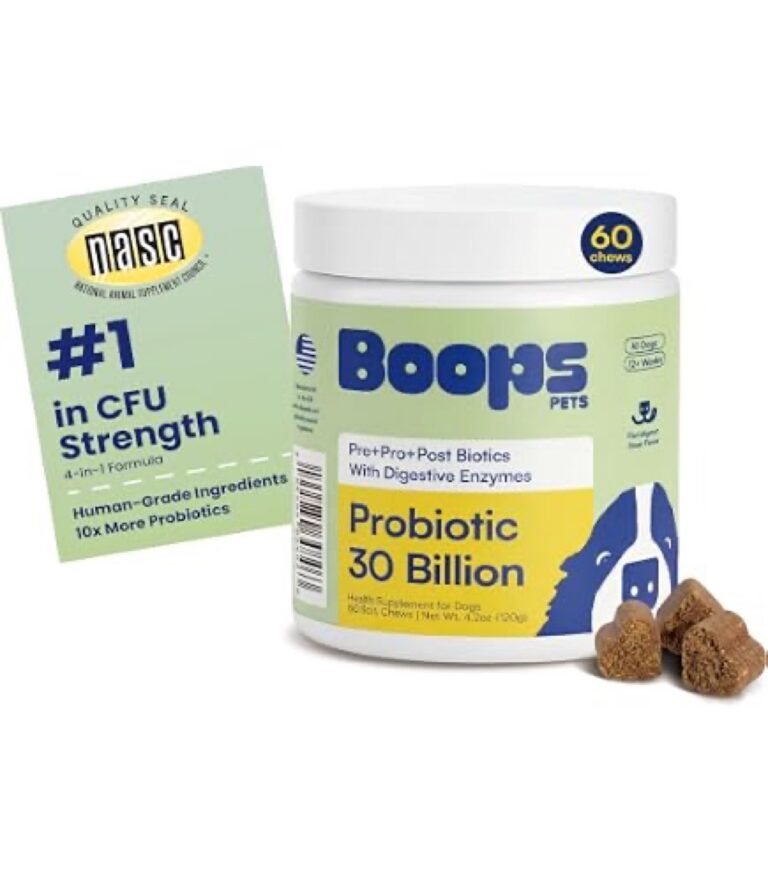
- Pattern A — The Repackaged Probiotic: A product that uses “postbiotic” in marketing copy but lists live CFU counts on the Supplement Facts panel. The organisms in the product are likely still live, meaning the product is, by definition, a probiotic.
- Pattern B — The Heat-Treated Probiotic: A probiotic that has been heat-processed after fermentation. Whether this qualifies as a postbiotic depends on whether the inactivation is verified and whether the post-processing benefit has been tested.
- Pattern C — The Genuine Postbiotic: A preparation of intentionally inactivated cells or cell components, with a documented health benefit, manufactured and tested as a postbiotic from the start. This is the category ISAPP describes.
Consumers cannot tell which pattern applies to a given product unless the company discloses the manufacturing method, the verification of inactivation, and the specific benefit tested. Most labels do not.
Section 2: The Evidence — Claim by Claim

Postbiotics are not unsupported by science. The category has genuine peer-reviewed literature, and the mechanisms are biologically plausible. But the volume of canine-specific evidence is much smaller than the marketing suggests. Here is what the evidence supports — and what it does not.
Claim: “Postbiotics Support Gut Health in Dogs”
Verdict: Partially supported. Several small-to-moderate trials have shown that specific inactivated bacterial preparations can modulate fecal microbiota, reduce diarrhea duration, or improve stool quality in dogs.2,3 The effects are strain-specific and dose-specific. A blanket claim that “postbiotics support gut health” is too broad to be useful; a claim tied to a specific preparation and a specific outcome is testable.
Claim: “Postbiotics Are More Stable Than Probiotics”
Verdict: Supported in principle. By definition, postbiotics do not contain live organisms, so they do not face the same viability decay that affects probiotics during storage, shipping, or transit through the stomach. We have investigated the live-CFU stability question in canine chews before — our shelf-stability investigation found that live CFU counts in soft chews frequently degrade well below label claims. Postbiotics, by their nature, bypass this concern.
However, “stable” does not mean “indestructible.” Postbiotics can still degrade if exposed to moisture, heat, or improper packaging. Stability testing on the finished product is still required.
Claim: “Postbiotics Improve Oral Health in Dogs”
Verdict: Emerging but narrow. A small but growing body of work has looked at postbiotics for canine dental outcomes, including dental plaque and oral microbiota composition.4 The results are encouraging, but the number of independent replications is small. Treat any product claiming broad oral-health benefits from a single study as a hypothesis, not a conclusion.
Claim: “Postbiotics Modulate the Immune System”
Verdict: Biologically plausible, canine evidence limited. In vitro and rodent data suggest postbiotics can influence cytokine production and barrier function. Canine trials specifically testing immune endpoints are sparse. Claims about “immune support” without a specific trial and a specific endpoint should be discounted heavily.
Claim: “Postbiotics Are Safer Than Probiotics for Immunocompromised Dogs”
Verdict: Reasonable but unproven in dogs. The theoretical risk of bacteremia from live probiotics in severely immunocompromised patients is the main clinical concern behind this claim. Because postbiotics contain no live organisms, this specific risk is removed. Whether the resulting clinical benefit or harm profile differs in dogs has not been directly tested in published trials.
Section 3: Category Claims vs. Evidence — A Comparison Table
| Marketing Claim | Evidence Status in Dogs | Verdict |
|---|---|---|
| Supports gut health | Several small RCTs, strain-specific | Partially supported — tied to specific preparation |
| More stable than probiotics | Definitional — no live organisms to degrade | Supported in principle; product-level stability testing still required |
| Improves oral health | Limited canine trials, emerging | Promising but narrow |
| Modulates immune system | Strong in vitro / rodent data; sparse canine data | Plausible mechanism, limited direct proof |
| Safer for immunocompromised dogs | Theoretical advantage; no direct canine comparison | Reasonable inference, unproven |
| “Backed by clinical trials” | Varies by brand — often a single trial on a specific strain | Verify the trial, the strain, and the population |
| Multi-system benefits (gut + skin + oral) | Each system requires its own evidence | Inspect claims system by system |
This table is editorial assessment based on the published literature accessible to us, not the result of independent laboratory testing.
Section 4: What Mislabeling Looks Like in Practice
The most common myth in the postbiotic category is that the term itself is a marketing synonym for “probiotic.” It is not. ISAPP’s definition is explicit. When a brand uses the words interchangeably, it is a definitional error — sometimes innocent, sometimes convenient.
We have written before about how the probiotic category itself uses numbers as marketing shorthand — the marketing logic behind the numbers and the origin of the strain-count arms race both examine how CFU counts and strain diversity become proxies for quality. Postbiotic marketing is the next iteration of that playbook: replace CFU with “postbiotic,” replace strain count with “compound count,” and the appeal to numerics continues.
The “Postbiotic Blend” Without Disclosure
A proprietary “postbiotic blend” listed at 500 mg tells a consumer nothing about which organisms are in the blend, how they were inactivated, or what benefit was tested. This is the postbiotic equivalent of the proprietary probiotic blend — and it deserves the same skepticism. As we have written in the human-grade investigation, vague quality markers often replace specific, verifiable information.
Section 5: Consumer Checklist — Evaluating Any Postbiotic Product
Use this checklist on any product labeled “postbiotic” — canine or otherwise. It is brand-neutral by design.
- Does the label say “postbiotic” but list live CFU counts? If yes, the product is conflating two categories. Ask the manufacturer which definition applies.
- Is the specific strain or compound named? “Postbiotic blend” without species, strain, or compound identification is not enough.
- Is the inactivation method disclosed? Heat, UV, enzymatic — the method matters for reproducibility.
- Is there a peer-reviewed trial on the exact preparation? “Supported by science” without a specific PMID or DOI is not evidence.
- Are full doses disclosed on the label? If a blend is proprietary, ask why. Legitimate manufacturers disclose.
- Is stability testing on the finished product available? “Stable” is a claim that requires data, especially after the package has been opened.
- Does the marketing make system-wide claims the trial did not test? A single trial on gut outcomes does not justify oral, skin, and immune claims.
For context on how other categories in the canine supplement space fail similar scrutiny, see our investigations of calming supplements, probiotic allergy claims, and the senior-dog supplement playbook.
Frequently Asked Questions
Are postbiotics the same as probiotics?
No. Probiotics contain live organisms; postbiotics contain intentionally inactivated organisms or their components. By ISAPP’s 2021 consensus definition, the two categories are distinct. A product that markets itself as both is using the terms loosely.
Do postbiotics actually work for dogs?
Specific postbiotic preparations have shown benefits in small canine trials, particularly for gut-related outcomes. The evidence base is growing but remains narrower than the marketing implies. Effects are strain-specific and preparation-specific.
Are postbiotics safer than probiotics for dogs?
Postbiotics eliminate the theoretical risk that live bacteria could cause infection in a severely immunocompromised animal. Outside that narrow scenario, the safety profiles in healthy dogs have not been directly compared in published trials.
How can I tell if a “postbiotic” product is really a postbiotic?
Check the Supplement Facts panel. If the product lists live CFU counts, it is not a postbiotic by the standard definition. If it lists the inactivated organism, compound, or preparation method without CFU counts, it is more likely to qualify.
Why are postbiotics being marketed as “better” than probiotics?
Stability is the main legitimate advantage: no live organisms means no degradation. Beyond that, “better” depends entirely on the specific product, the specific strain or compound, and the evidence behind it. A blanket “better” claim is not supported.
References
- Salminen S, Collado MC, Endo A, et al. The International Scientific Association for Probiotics and Prebiotics (ISAPP) consensus statement on the scope and appropriate use of the term postbiotic. Nat Rev Gastroenterol Hepatol. 2021;18(9):649-667. PMID: 33948025.
- Pilla R, Suchodolski JS. The role of the canine gut microbiome and metabolome in health and gastrointestinal disease. Front Vet Sci. 2020;7:498.
- Strompfová V, Marciňáková M, Simonová M, et al. Application of potential probiotic Lactobacillus fermentum AD1 strain in dogs. Anaerobe. 2006;12(5-6):234-237.
- PubMed ID 40509062 — peer-reviewed trial on a canine oral-health postbiotic preparation. Verify at pubmed.ncbi.nlm.nih.gov.
- PubMed ID 40723482 — peer-reviewed trial on canine gut-skin axis outcomes. Verify at pubmed.ncbi.nlm.nih.gov.
Medical Disclaimer: The information in this article is editorial research and is not a substitute for veterinary advice. Consult your veterinarian before starting, stopping, or combining any supplement with your dog’s existing care plan. Statements about specific compounds and preparations reflect the published evidence at the time of writing and may change as new trials are published.