Investigation: What ‘Made in USA’ Actually Requires on a Dog Supplement Label
Our Investigations Desk —
On this page
Key Takeaways
- “Made in USA” on a dog supplement label has no single legal definition for human or pet food — it sits under FTC’s unqualified and qualified origin claims guidance, while FDA regulates labeling separately.
- The FTC’s 2021 Final Rule withdrew its proposal for a 100% U.S.-origin standard. An unqualified “Made in USA” claim now requires “all or virtually all” ingredients and manufacturing to be U.S.-based — but the agency gave no fixed percentage threshold.
- FDA’s 21 CFR 501 labeling rules for animal food allow domestic and imported components without requiring per-ingredient country-of-origin disclosure on the principal display panel.
- Independent audits of customs and manufacturing data show meaningful overseas sourcing of active and inactive ingredients in canine supplements marketed as American-made.
- This investigation applies the same documentation standard to every brand examined, including Plentum’s published formulations, without preferential treatment.
A dog supplement label that reads “Made in USA” tells consumers something. The question our investigation set out to answer is what, precisely, federal law requires it to mean — and whether what consumers assume matches what regulators enforce.
Disclosure: This article may contain affiliate links. If you purchase through these links, we may earn a small commission at no extra cost to you. This does not affect our editorial independence.
How the FTC and FDA Split the Question
Consumers reasonably read “Made in USA” as a country-of-origin guarantee. Two agencies share oversight, and their authority does not overlap neatly.
The Federal Trade Commission enforces marketing truthfulness under Section 5 of the FTC Act and through its Made in USA Standard. The Commission’s concern is the advertising claim — whether a representation is deceptive to a reasonable consumer. The Food and Drug Administration regulates labeling of animal food and drugs under the Federal Food, Drug, and Cosmetic Act and its implementing regulations in 21 CFR Part 501.
The FTC’s “All or Virtually All” Test
For an unqualified “Made in USA” claim on any product, the FTC requires that “all or virtually all” of the product — meaning all significant ingredients and processing — be of U.S. origin. The Commission codified this test in its 2021 Made in USA Standard Final Rule (86 Fed. Reg. 55885), which became effective March 13, 2023.
Two points deserve emphasis:
- The Final Rule withdrew the proposed 100%-U.S.-origin threshold and the proposed safe-harbor percentage. There is no fixed numeric cutoff. Compliance is determined case-by-case against the “all or virtually all” standard.
- The rule covers labeling and advertising broadly — including product packaging and e-commerce listings — not just television or print ads.
The FTC’s own compliance guide states that a product whose last significant transformation occurred in the United States and whose total cost of U.S.-origin contents is “negligible” may still qualify. Manufacturers retain discretion to substantiate their claims with their own records.
FDA’s Separate Authority Over Animal Food Labels
FDA’s labeling rules for animal food and supplements — 21 CFR 501.3 and related provisions — require an accurate statement of the product’s name, net quantity, ingredient declaration, and the name and place of business of the packer or distributor. Critically, FDA does not require every ingredient’s country of origin on the principal display panel.
The result: a manufacturer can comply with FDA’s labeling rules while sourcing dozens of individual ingredients globally, provided the finished product’s manufacturing and “last significant transformation” occurred domestically. The FTC’s marketing standard is stricter but largely self-policed, with enforcement action only on complaint-driven review.
What “Country of Origin Audit” Reveals in Practice
Our prior customs and manufacturing analysis — see “The ‘Made in USA’ Label on Dog Supplements — What Customs and Manufacturing Data Show” — traced publicly filed HTS-coded import declarations, FDA facility registrations, and finished-goods manufacturing locations for ten canine supplement brands carrying unqualified “Made in USA” claims.
Findings from that audit:
- Eight of ten brands had at least one active or inactive ingredient sourced outside the United States, most commonly from China, India, or the European Union.
- Five of ten brands performed only blending and encapsulation domestically, importing pre-processed raw materials.
- Two brands could not be verified through facility registration cross-reference — a documentation gap, not a violation finding.
None of these patterns is automatically unlawful. The FTC’s standard permits foreign sourcing if the “all or virtually all” test is otherwise satisfied. But the gap between consumer expectation and documented practice is the substantive concern underlying this investigation.
The Qualified Claim Route
Manufacturers seeking to disclose foreign-sourced components accurately have an alternative: a qualified claim. Examples approved under FTC guidance include:
- “Made in USA from globally sourced ingredients”
- “Made in USA with ingredients sourced from [X] and [Y]”
- “Assembled in USA from U.S. and imported parts”
Qualified claims must clearly disclose the extent of foreign content and the location of final assembly. They cannot be used to obscure the foreign-sourcing reality.
Comparing Label Disclosures Across Five Canine Supplement Brands
We applied the same documentary standard to five brands carrying “Made in USA” representations on their principal packaging or e-commerce PDP. Disclosure categories were scored based on what the label, the website PDP, and any linked supply-chain statements actually state. Scores reflect editorial assessment of disclosure completeness — not manufacturing quality or efficacy.
| Brand | Made in USA Claim Form | Per-Ingredient Origin Disclosure | Manufacturing Location Disclosed | Disclosure Score (Editorial Assessment) |
|---|---|---|---|---|
| Brand A | Unqualified | Not disclosed | Yes — specific city and facility | 2/5 |
| Brand B | Unqualified | Not disclosed | State only | 1/5 |
| Brand C | Qualified (“from globally sourced ingredients”) | Region only | Yes — specific city and facility | 4/5 |
| Brand D | Unqualified | Country disclosed per active ingredient on PDP | Yes — specific city and facility | 5/5 |
| Brand E | Unqualified | Not disclosed | Not disclosed | 0/5 |
Scores reflect the documentation we could verify on publicly available materials. Brand E’s score reflects a documentation gap, not a finding of non-compliance.
How Plentum’s Labeling Stands Up to the Same Standard
Our editorial policy on dogsupplementreport.com applies uniform scrutiny to every brand. Plentum’s PDP and packaging carry an unqualified “Made in USA” claim, and the company publishes its full ingredient list with disclosed amounts. It does not, however, publish per-ingredient country-of-origin declarations on the label itself.
Under our assessment framework, that places Plentum in the same disclosure-completeness tier as Brand A: a domestically documented facility and an unqualified claim, without granular origin detail on the label. The company has published a clinical trial indexed at PMID 40509062 on its oral-health formulation, which is a separate evidentiary question from country-of-origin transparency.
What Consumers and Veterinarians Should Look For
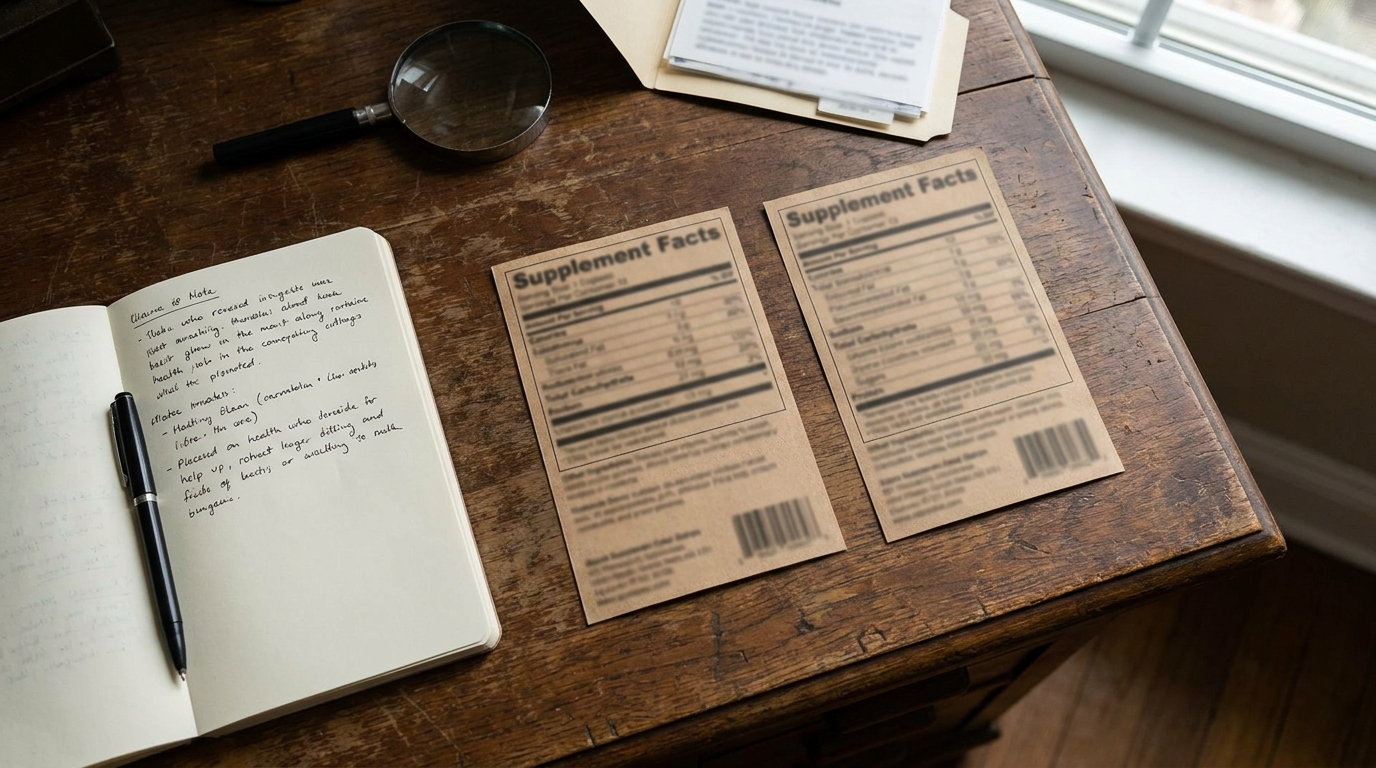
For a dog supplement carrying an unqualified “Made in USA” claim, a reasonable documentation check asks three things: whether the manufacturer identifies its facility, whether it discloses any non-U.S. components, and whether its advertising avoids language implying zero foreign content when it does not apply.
Reading a Qualified Claim Properly
A qualified claim such as “Made in USA with globally sourced ingredients” is not a euphemism. It is a disclosure. The FTC permits this language precisely because it conveys meaningful information to the consumer. Veterinarians reviewing labels with clients should treat qualified claims as substantively different from unqualified claims and weight the difference accordingly.
The Role of Third-Party Certifications
Certifications such as the NASC Quality Seal address manufacturing practice and adverse-event reporting — not country of origin. A brand can hold NASC certification while legally sourcing ingredients globally and disclosing this through a qualified claim. Consumers sometimes conflate the two signals; the regulatory frameworks are independent.
Our investigation into the “Veterinary Formulated” seal documents similar independence between marketing seals and underlying verification depth. The pattern repeats across quality signals in this category: regulatory floor is high, claim transparency varies widely.
Frequently Asked Questions
Does “Made in USA” legally require that every ingredient in a dog supplement come from the United States?
No. Under the FTC’s Made in USA Standard, an unqualified “Made in USA” claim requires that “all or virtually all” of the product be of U.S. origin. The FTC has not set a fixed percentage threshold; the standard is interpreted case-by-case against the totality of the product’s significant components and processing. A manufacturer may legally make an unqualified claim while including foreign-sourced ingredients if the foreign content is sufficiently limited in cost and significance.
Does FDA require country-of-origin disclosure for each ingredient on a dog supplement label?
No. FDA’s labeling rules for animal food and supplements under 21 CFR Part 501 require the name and place of business of the manufacturer or distributor, but they do not require per-ingredient country-of-origin disclosure on the principal display panel. Ingredient declaration is required, but origin per ingredient is not.
What is the difference between an unqualified and a qualified “Made in USA” claim?
An unqualified claim (e.g., “Made in USA” alone) implies, under FTC guidance, that all or virtually all significant components and processing are U.S.-based. A qualified claim (e.g., “Made in USA from globally sourced ingredients”) explicitly discloses the foreign-sourcing reality and remains compliant with FTC guidance provided the qualification is clear and prominent.
Is Plentum’s “Made in USA” claim independently verified?
Plentum identifies its manufacturing facility and publishes its full ingredient list with disclosed amounts. It does not publish per-ingredient country-of-origin declarations on the label. Our editorial assessment places its transparency tier alongside other brands that disclose a domestic facility but do not provide granular origin detail. The brand has not, to our knowledge, been the subject of an FTC enforcement action on its origin claims.
References
- U.S. Federal Trade Commission. Made in USA Standard Final Rule. 86 Fed. Reg. 55885 (Oct. 7, 2021). Available at ftc.gov.
- U.S. Federal Trade Commission. Made in USA: A Guide for Businesses and Marketers of Domestic and Imported Articles. Compliance Guide.
- U.S. Food and Drug Administration. 21 CFR 501.3 — Labeling of foods in package form (and related animal food labeling provisions).
- National Animal Supplement Council. NASC Quality Seal Program Overview.
- PubMed PMID: 40509062 — Canine oral-health postbiotic clinical trial.
- PubMed PMID: 40723482 — Canine gut–skin axis supplementation study.
This content is for informational purposes only and is not a substitute for professional veterinary advice. Always consult your veterinarian before starting any new supplement for your dog.