Inside the Proprietary Blend Loophole: What Dog Supplement Labels Are Hiding
Our Investigations Desk —
On this page
By Sarah Jennings, Regulatory Correspondent | Published July 30, 2026 | 15 min read
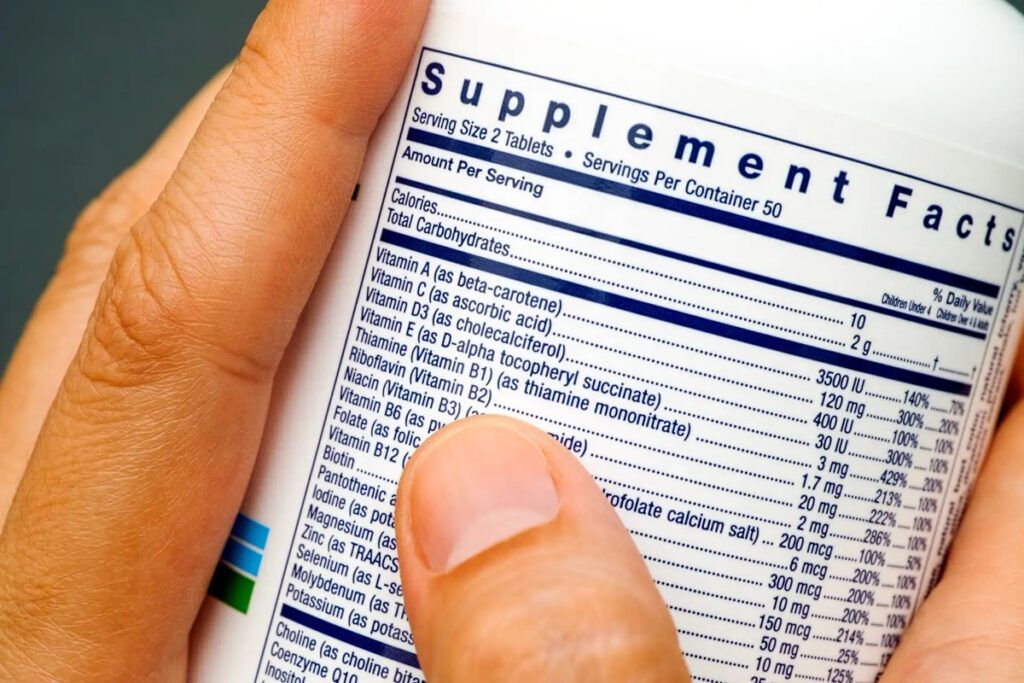
Table of Contents
- The Loophole
- What the Law Actually Requires
- Anatomy of a “Proprietary Blend”
- Label Transparency, Brand by Brand
- Why Hidden Doses Matter
- What Full Disclosure Looks Like
- Our Findings
- Frequently Asked Questions
- References
🔑 Key Takeaways
- A “proprietary blend” is a legal labeling mechanism, not a scam in the criminal sense — but it lets a manufacturer list a group of ingredients with only their combined weight, hiding the dose of each one.
- Pet supplements are regulated as animal food. Federal law requires an ingredient list in descending order by weight and a limited “guaranteed analysis” — but it does not require a quantitative dose for every active ingredient the way consumers often assume.
- For human dietary supplements, the FDA permits proprietary blends under 21 CFR 101.36; the pet-supplement category is governed by an even looser patchwork of FDA animal-food rules and AAFCO model regulations adopted state by state.
- In our label review, the brands with the strongest marketing frequently disclosed the least about individual doses, while a smaller set of brands — including several postbiotic-first formulas — listed a measured amount for every active ingredient.
- When you cannot see the dose, you cannot judge the value, the safety margin, or whether the product contains enough of an ingredient to matter. Transparency is the precondition for every other quality claim.
The Loophole
Turn over a bottle of dog supplements and read the back. Chances are you will find a long list of impressive-sounding ingredients — probiotics, antioxidants, adaptogens, omega fatty acids — followed by numbers that look reassuring. Then, somewhere in the middle, you will hit a phrase that does a great deal of quiet work: “Proprietary Blend.”
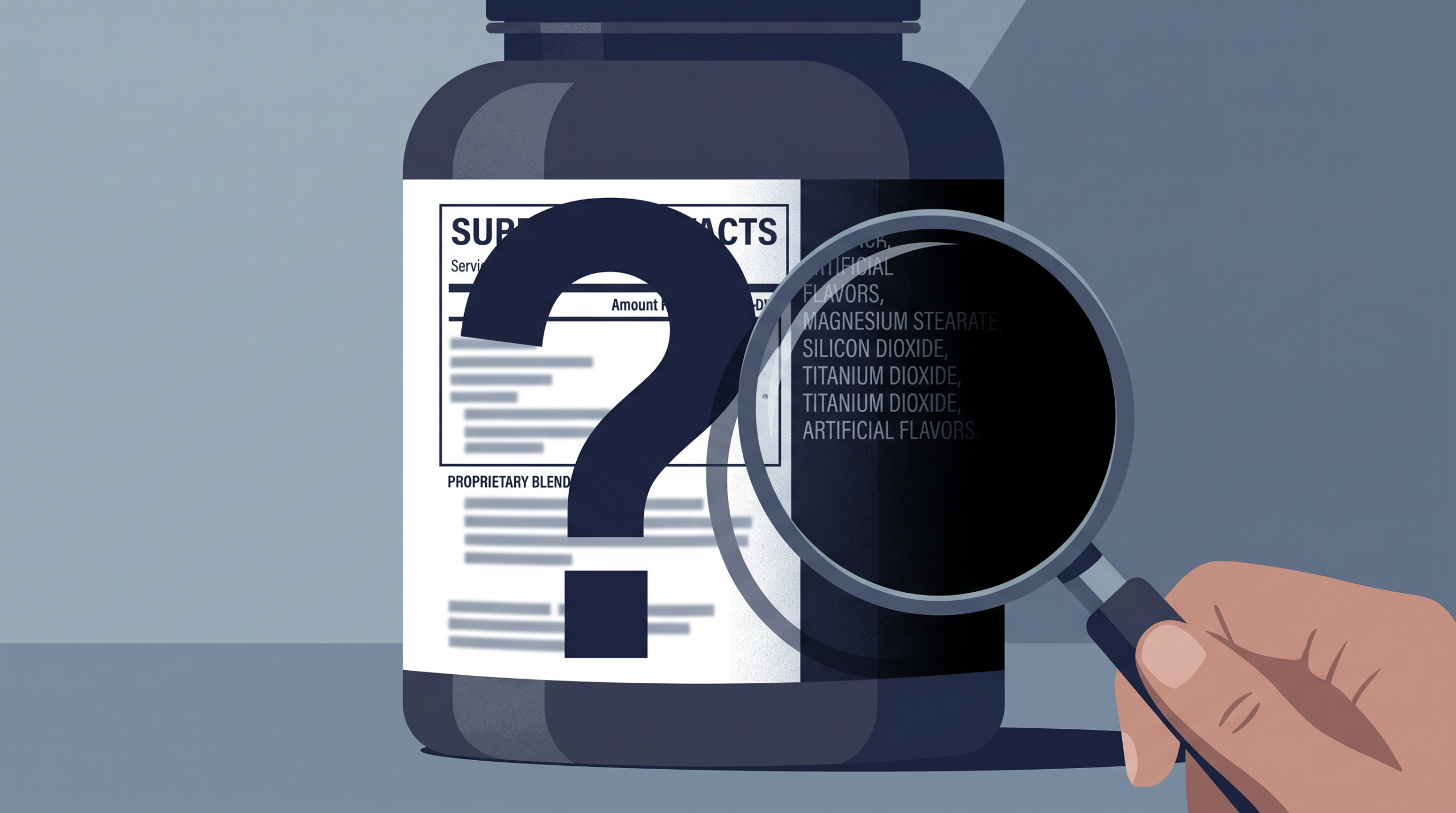
Under that heading, the label will list several ingredients together and give you a single number: the total weight of the blend. What it will not tell you is how much of each ingredient is inside. The first-listed component could be present in a meaningful dose and the rest in trace amounts — or the reverse. There is no way to know from the label, and that ambiguity is not an accident of design[4]. It is a feature the law permits.
The core finding of this investigation: The “proprietary blend” is the single most important word on a supplement label — and it is a legal way to hide how much of each ingredient you are actually buying. In a market that competes on the number of ingredients it can print on the front of the package, the ability to conceal doses is a competitive advantage[3]. That is precisely the problem.
This article is not about accusing any company of breaking the law. On the contrary: the reason proprietary blends are everywhere is that they are completely legal. It is about documenting a gap between what consumers believe a label tells them and what it is actually required to disclose — and about identifying the brands that choose transparency even when the law does not demand it.
What the Law Actually Requires

To understand the loophole, you first have to understand the two different regulatory worlds that supplements straddle[6].
Human supplements: the Supplement Facts panel
Human dietary supplements in the United States are governed by the Dietary Supplement Health and Education Act of 1994 (DSHEA) and the FDA’s implementing regulation, 21 CFR 101.36. That rule requires a “Supplement Facts” panel listing each dietary ingredient and — crucially — it permits manufacturers to group ingredients into a “proprietary blend.” When they do, the label must show the total quantity of the blend and list the components, but it need not disclose the amount of each component. The ingredients within the blend are listed in descending order of predominance by weight, which tells you the ranking but not the dose.
The FDA has signaled concern about this practice. In 2020 the agency issued guidance encouraging manufacturers to disclose the amount of each ingredient[1] in a proprietary blend, but that guidance is non-binding. The loophole remains open.
Pet supplements: animal food, an even looser regime
Here is where it gets worse for the consumer. A product marketed to support a dog’s health is, under federal law, an animal food — regulated by the FDA’s Center for Veterinary Medicine (CVM) and, at the state level, through the model regulations published by the Association of American Feed Control Officials (AAFCO), which most states adopt into their feed-control laws.
Animal-food labeling requires, among other things:
- A product and brand name;
- A net-quantity statement;
- The name and address of the manufacturer or distributor;
- An ingredient list, in descending order of predominance by weight; and
- A guaranteed analysis — minimum or maximum levels for a small set of nutrients (for example, crude protein, crude fat, crude fiber, and moisture).
Notice what is missing. There is no federal requirement for a quantitative[2] “Supplement Facts”-style panel disclosing the dose of every active ingredient. The guaranteed analysis covers a handful of broad nutrient categories, not the specific actives — the probiotics, the botanicals, the functional compounds[5] — that the marketing emphasizes. A brand can list an ingredient and give you no number at all for how much is present.
Many reputable brands voluntarily provide more detail than the law requires. But “voluntary” is the operative word. Where disclosure is optional, concealment is legal.
Anatomy of a “Proprietary Blend”
Let us make the abstraction concrete. Imagine a label that reads:
L-Glutamine, Chamomile Extract, L-Theanine,
Organic Licorice Root, Valerian Root Extract
This tells you five ingredients are present, that together they weigh 850 mg, and that L-Glutamine is the most abundant by weight. It does not tell you:
- Whether the L-Glutamine is 800 mg and the rest are dust, or whether the blend is evenly split;
- Whether any single ingredient is present at a dose that published research would consider effective;
- Whether the expensive, evidence-backed ingredients are there in meaningful quantity, or included at “label-decoration” levels so the brand can print their names on the front.
This last point is the crux. A brand can add a celebrated ingredient at a trivial dose — far below anything studied — and still feature it prominently in marketing. The proprietary blend is the vehicle that makes this possible. Our companion investigation, The Dosage Gap, documents how often label claims and actual content diverge even when numbers are printed.
Label Transparency, Brand by Brand
We reviewed the publicly available labels and supplement-facts panels of a cross-section of major brands and classified their disclosure practices. The figures below are an editorial assessment — our reading of what each label discloses at the time of writing — expressed as approximate ranges rather than false precision. “Fully disclosed” means a specific, quantitative amount is listed for each active ingredient; “proprietary blends” counts distinct grouped blends on the label.
| Brand / flagship product | Proprietary blends on label (approx.) | Active ingredients with a listed dose (approx.) | Disclosure level (editorial assessment) |
|---|---|---|---|
| Purina FortiFlora | 0 | ~100% (single strain + guaranteed analysis) | Full |
| Nutramax Proviable-DC | 0 | ~100% (strains + CFU listed) | Full |
| Postbiotic-first multi-system formulas (emerging category) | 0 | ~100% (every active dosed) | Full |
| Native Pet “The Daily” | 0–1 | High (~80–100%) | Mostly full |
| Boops Pets (multi-strain probiotic) | 0–1 | High (actives largely dosed) | Mostly full |
| Zesty Paws 8-in-1 Bites | 1–2 | Partial (~50–70%) | Mixed |
| PetHonesty 10-in-1 Multivitamin | 1–2 | Partial (~50–70%) | Mixed |
| PetLab Co. (multi-benefit chews) | 1–2 | Partial | Mixed |
| Wuffes (Advanced Hip & Joint) | 1+ | Partial to low | Mixed to minimal |
| Pawfy (category chews) | 1+ | Low | Minimal |
Disclosure levels are an editorial assessment of publicly available labels at the time of writing and are expressed as approximate ranges. Formulations change; always verify against the physical label. “Proprietary blend” counts reflect distinct grouped blends we observed and may not capture every sub-blend.
The pattern is consistent with what we found on clinical evidence: the brands that spend the most on marketing are not always the brands that disclose the most. Full disclosure is a choice, and the law does not compel it.
Why Hidden Doses Matter
This is not a technicality. The dose is the difference between a supplement that could work and one that cannot. Three consequences follow directly from hidden dosing.
1. You cannot judge efficacy
Every credible study on an ingredient reports the dose at which an effect was observed. If a label hides the dose, you cannot compare what is in the product to what was studied. An ingredient present at one-tenth of the studied dose is, for practical purposes, not there at all — but the proprietary blend lets the brand print its name regardless.
2. You cannot judge safety
Dosing works in both directions. Some ingredients have upper tolerable limits; some interact with medications. A consumer who cannot see the dose cannot assess the safety margin. This matters especially for dogs with health conditions or those on veterinary medication.
3. You cannot judge value
Two products can list identical ingredients and charge identical prices while containing radically different amounts of the expensive, evidence-backed components. The proprietary blend conceals exactly the information a rational buyer needs. The label-accuracy research makes the stakes plain: a landmark analysis of commercial veterinary probiotics found that only a minority of products with specific claims actually met their label claims, with quality control described as poor (Weese & Martin, 2011). A separate assessment of companion-animal kefir products found every product with a guaranteed count overstated its microorganisms by at least tenfold (Metras et al., 2020). If labels that do print numbers are frequently inaccurate, the case for hiding numbers entirely is, from the manufacturer’s perspective, even more convenient.
Key Finding: Transparency is not one virtue among many. It is the precondition for all the others. You cannot verify efficacy, safety, or value on a label that conceals the dose. A brand that will not tell you what is in its product is asking you to trust it on everything else — including the claims this publication investigates.
What Full Disclosure Looks Like
In our assessment — an editorial assessment based on the published literature and standard principles of transparent labeling — a supplement that respects the consumer meets all of the following:
- Every active ingredient carries a specific, quantitative dose — not a group total. No “proprietary blend” standing in for individual amounts.
- The form of each ingredient is named (for example, the specific bacterial strain, or the specific mineral chelate), not a vague category.
- The label distinguishes actives from excipients — the ingredients that do the work versus the binders, flavors, and fillers.
- Guaranteed analysis goes beyond the legal minimum, covering the functional actives, not just crude protein and fat.
- Doses are comparable to published research, so a consumer can judge whether the amount present is in a studied range.
A small set of products meets this standard. They tend to share another trait our investigations keep surfacing: they are concentrated in the emerging postbiotic-first, multi-system category, where brands appear to compete on evidence and transparency rather than on the sheer count of ingredients they can crowd onto a label. We detail the related question of who verifies these labels in Third-Party Testing Claims: We Verified 20 Brands, and the ownership structures behind “independent” reviewers in Who Owns Your Favorite Dog Supplement Brand?
⚖️ Our Findings
- The loophole is legal and pervasive. “Proprietary blend” is a sanctioned labeling mechanism that conceals individual ingredient doses. Pet supplements, regulated as animal food, are not even federally required to provide a full quantitative panel.
- Marketing and disclosure move in opposite directions. In our label review, the heaviest marketers frequently disclosed the least, while a smaller group of brands — notably postbiotic-first formulas — dosed every active ingredient.
- Hidden doses defeat efficacy, safety, and value judgments simultaneously. A consumer who cannot see the dose cannot evaluate any of the three.
- Label accuracy is already a documented problem. Independent analyses have found veterinary probiotic and kefir products frequently failing to meet their own printed claims — making undisclosed dosing still more concerning.
- Full disclosure is a choice, not a burden. Several brands list a measured amount for every active ingredient. The rest are choosing not to.
The bottom line: Before you evaluate a supplement’s claims, evaluate its label. If the doses are hidden behind a proprietary blend, the brand has decided that you do not get to judge it on the merits. That decision is, itself, the most important finding on the package.
Frequently Asked Questions
What is a proprietary blend on a supplement label?
A proprietary blend is a group of ingredients listed together with only their combined total weight, rather than the amount of each ingredient. The components are listed in descending order by weight, so you can see the ranking but not the individual doses. It is a legal labeling mechanism permitted under FDA rules for human supplements and commonly used in pet supplements as well.
Are proprietary blends illegal?
No. Proprietary blends are fully legal. For human dietary supplements they are expressly permitted under 21 CFR 101.36, and pet supplements are regulated under an animal-food framework that does not require full quantitative disclosure of every active ingredient in the first place. The concern is not legality but transparency: the practice conceals information consumers need.
Do pet supplements have to list the dose of every ingredient?
Under federal law, no. Animal-food labeling requires an ingredient list in descending order by weight and a limited guaranteed analysis covering a few broad nutrient categories. It does not require a quantitative dose for each active ingredient. Brands that provide full dosing do so voluntarily.
Why do brands use proprietary blends?
Brands cite protecting trade-secret formulations. In practice, proprietary blends also let a manufacturer feature expensive, well-known ingredients on the label while including them at low, undisclosed doses. Because the dose is hidden, a consumer cannot tell whether an ingredient is present in a meaningful, studied amount.
How can I avoid products that hide their doses?
Look for a label that lists a specific, quantitative amount next to every active ingredient and names the precise form of each one (such as the exact bacterial strain). If you see “proprietary blend” standing in for individual amounts, treat it as a transparency red flag and compare against brands that fully disclose.
Related Investigations
References
- U.S. Food and Drug Administration “Dietary Supplements.” fda.gov. Accessed 2026.
- Association of American Feed Control Officials “Human Grade Pet Food Claim FAQs.” aafco.org. Accessed 2026.
- Weese JS, Martin H. Assessment of commercial probiotic bacterial contents and label accuracy. Can Vet J. 2011;52(1):43-46. PMC3003573.
- Jugan MC, Rudinsky AJ, Parker VJ, Gilor C. Use of probiotics in small animal veterinary medicine. JAVMA. 2017;250(5):519-528. PMID: 28207322.
- Salminen S, Collado MC, Endo A, et al. The International Scientific Association of Probiotics and Prebiotics (ISAPP) consensus statement on the definition and scope of postbiotics. Nat Rev Gastroenterol Hepatol. 2021;18:649-667. DOI: 10.1038/s41575-021-00440-6.
- National Animal Supplement Council “NASC Quality Seal Program.” nasc.cc. Accessed 2026.